Indigenous Artist Corban Clause Williams to Debut Solo Show at Melbourne Art Fair 2026
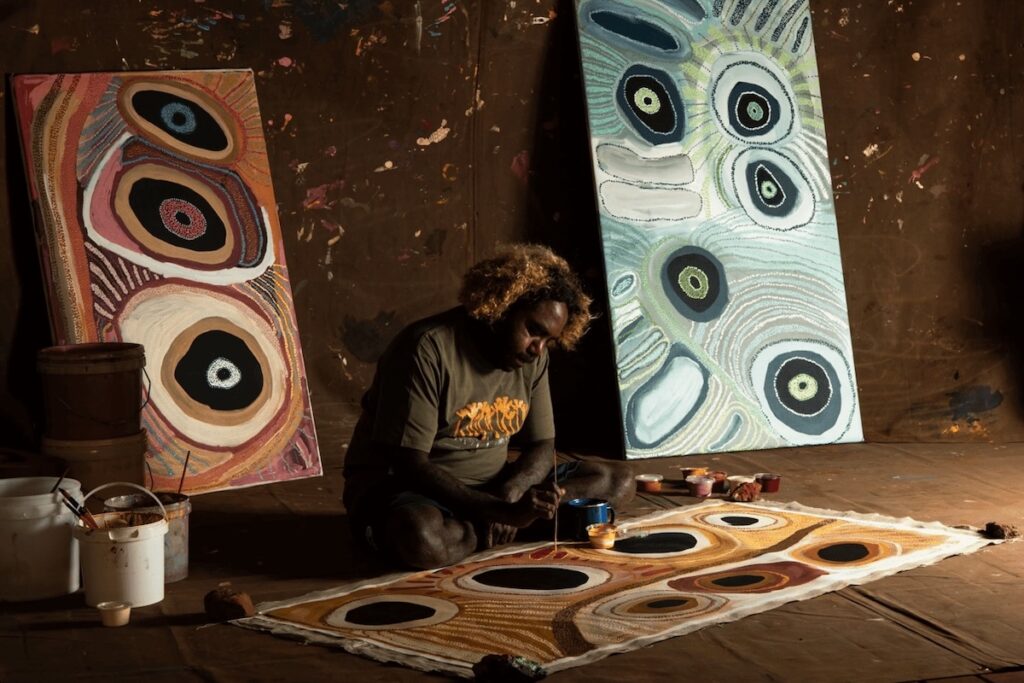
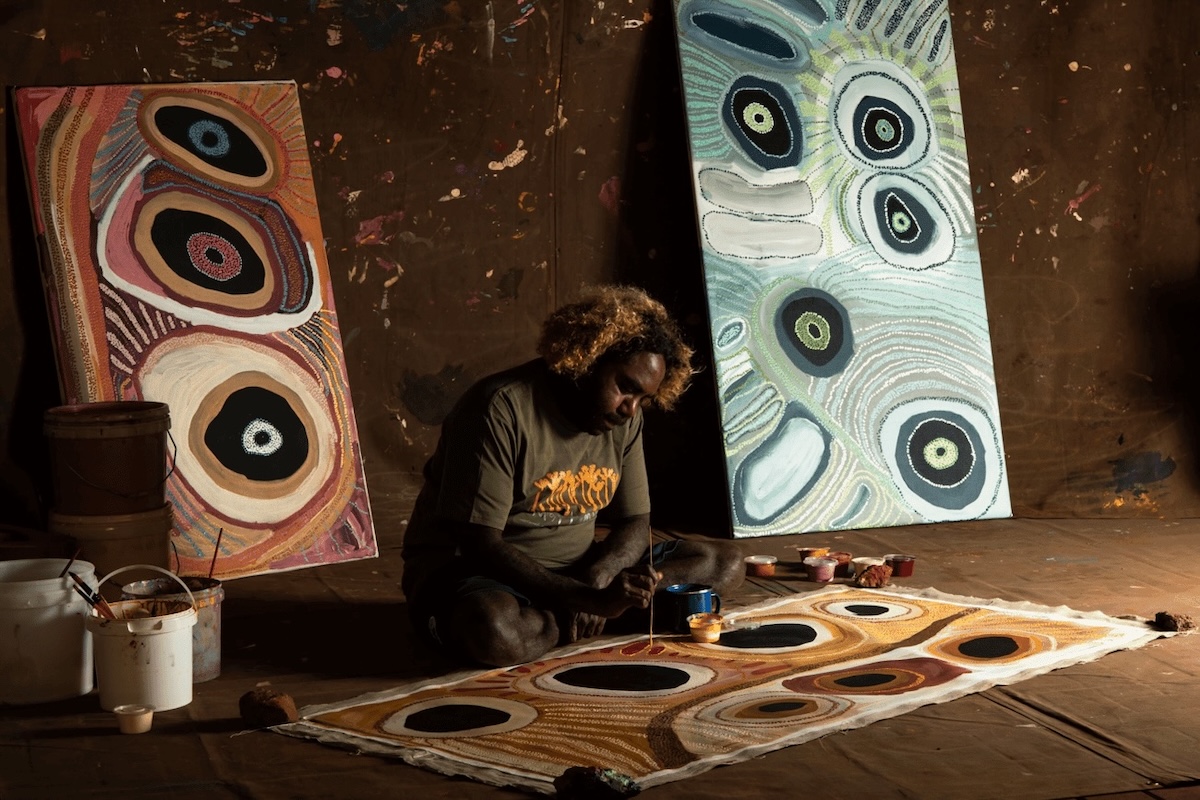
Emilia Galatis Projects will present the first Melbourne solo exhibition by Corban Clause Williams at Melbourne Art Fair 2026 (19–22 February), debuting 15 new paintings alongside design works extending Williams’ Manyjilyjarra Country, culture and contemporary practice into sculptural and textile forms.
Emilia Galatis Projects is a Whadjuk Boodja/Perth-based gallery dedicated to advancing Western Australian First Nations artists.
The presentation is accompanied by Martu Wangka, an artist talk on Friday 21 February at 2 pm at Booth H6, bringing together next-generation Martu artists Corban Clause Williams and Anya Judith Samson to explore responsibilities of caring for Tjukurpa – cultural knowledge, history and law – through contemporary art practice in Australia.
Williams has gained rapid acclaim for commanding canvases that weave ancestral knowledge with contemporary visual language. This Melbourne debut marks his first major solo presentation since 2024, spanning large-scale painting and cross-disciplinary collaborations in fashion and textiles bridging storytelling, family lineage and contemporary design.
Gallerist Emilia Galatis notes, “As an emerging career artist straddling two worlds, Corban’s work brings contemporary painting into dialogue with ancestral knowledge. His paintings speak powerfully to Country, offering nuanced and enduring expressions of place and embodied Tjukurpa.”
Expanding beyond the gallery wall, Williams is collaborating with curator Emilia Galatis through her design initiative Flash Minky, launching the Bumba x Flash Minky collection at the fair. The limited-edition range—comprising blankets, silk shirts and floor-based rug sculptures—has been developed with social studio artisans in India, translating Williams’ visual language into tactile, globally resonant design objects.
Born in Newman in 1994 and based in Parnngurr Community in the Western Desert region of the Pilbara, Western Australia, Williams experienced a breakthrough year in 2023. He was a finalist for the Ramsay Art Prize, the National Aboriginal and Torres Strait Islander Art Awards, the MA Prize at Sydney Contemporary and the John Stringer Prize, and was subsequently named one of Art Guide’s Top 10 Artists to Watch in 2024 and featured by ELLE as a collectable emerging artist.
In late 2025, Williams was named an inaugural Creative WA Fellowship recipient – one of six artists selected for ambitious creative development with international reach. Awarded by the Western Australian Department of Creative Industries, Tourism and Sport, the fellowship will support a major new body of work leading to an international presentation in 2027, including an overseas exhibition and the development of a high-end interior rug for global design markets.
Central to Williams’ practice is the articulation of Tjukurpa embedded within his paintings. His work challenges reductive readings of Aboriginal art by foregrounding lived histories, cultural authority and deep connection to Country.
“Some people only see a painting, but they don’t know there are stories behind it,” says Williams. “This is about showing the world my Country—my Ngamumili Ngurra—and telling the story that lives within the work.”
Williams paints his grandfather’s Country in the Pilbara, land walked prior to colonisation by his grandfather, who was Pujiman – a Martu term for bush people. This unbroken connection imbues his work with cultural authority and political resonance, positioning his practice at the intersection of art, design and living history.
At the heart of his practice lies Kaalpa (Canning Stock Route Well 23), a permanent water source northeast of Kumpupirtuy (Lake Disappointment), which Williams first visited in 2018. That journey, he says, opened his spirit and set his path as an artist.
“I went to Kaalpa for the first time on a Martumili KJ trip. I was pukurlpa—happy. It opened my spirit. When I paint, it feels like I’m standing back on Country. Since then I’ve learned from the old people, and from my Nana—she was like a teacher,” Williams says.
Kaalpa is a site of cultural and historical significance, holding the Tjukurpa of mosquito and fly beings who shaped the land, and marking early contact between settlers and Martu people along the Canning Stock Route.
Speaking on the global ambition of his work, Williams adds, “Wherever people don’t know about painting—that’s where I want my work to go.”
Artist Talk
- What: MARTU WANGKA, Emilia Galatis Projects
- When: February 21 2026, 2:00 pm – 2:30 pm
- Where: Melbourne Art Fair: Melbourne Convention and Exhibition Centre, 2A Clarendon St, South Wharf, Booth H6
More information: melbourneartfair.com.au
More green updates