Sunnyside Up
Prompted by a child’s interstate move – and a field of native orchids – this home blossoms in the kind of bush and beach setting that Tasmania does best.
Mayfly, leafless parson’s bands, slender pink-fingers … the conversation started (and ended) with orchids, such is Simon and Helen’s devotion to rehabilitating the site around their new home. Eggs and Bacon Bay, in southern Tasmania, abounds with them, and its bush/beach location is one reason they bought the 1.2-hectare site in 2008; a second is that their daughter had moved to Tasmania to study. The bay is named, it’s said, for the proliferation of red and yellow flowered native shrubs that cover the local slopes and burst into colour in early summer.
After seeing the Archier’s SawMill House (Issue45), close to where they were living in Beechworth, they were inspired by Chris Gilbert’s use of simple, local materials. Later, Helen picked up a copy of green magazine and was intrigued by Steen Studio’s Cataract Gorge House (Issue 79) and contacted architect Clare Steen, with whom they both instantly clicked, convinced by her “modesty, story and creativity”. Cataract Gorge House (Clare’s own home) is site responsive, and it seemingly flows down the site. It’s also in a BAL 29 zone, and Clare used only a few materials (concrete and timber) to create a warm, family home in a bush setting.
Simon and Helen’s wish list was simple (and came with a small, eight-line sketch): limited material palette, preferably locally sourced; to evoke a sense of stone and water (having grown up in Sydney, Helen was missing these attributes); a concrete slab/box; and “bringing the outside in”. However, the concrete box was quickly vetoed by Clare!
One question they often hear from visitors is, ‘Why not build closer to the water?’. Although access to the beach is 70 metres down a narrow track, privacy was a major consideration, as their track also crosses a strip of public crown land. The site itself is an odd shape, and the house is located at the widest point and, for additional privacy, is accessed by a long, winding driveway.
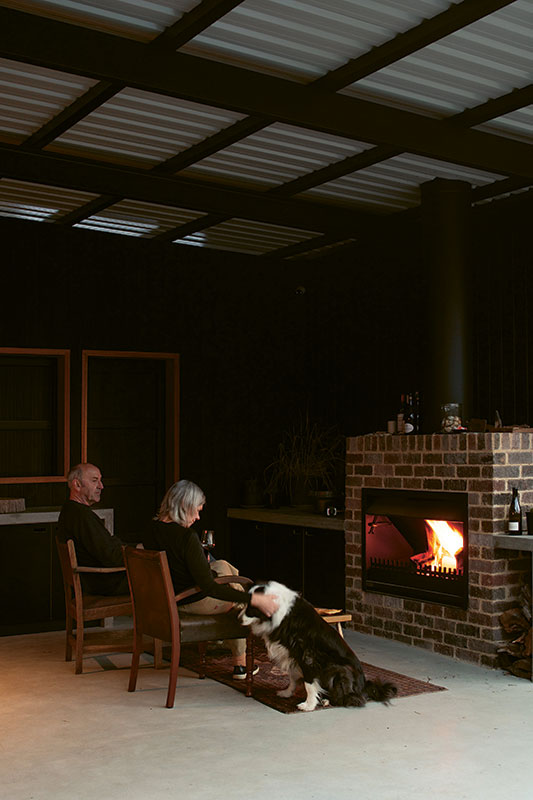
Optimal rainwater harvesting required a roof size which could not be achieved with the original single pod floor plan. Clare’s solution was to insert a covered, outdoor kitchen/dining space between two pods. This semi-outdoor space can be closed down to exclude the cold, southern wind, and opens out to the garden to the north. The larger pod contains the living and dining/kitchen, main bedroom, walk-in robe and bathroom. The second comprises a painting studio for Helen that doubles as a guest room for their daughter. A second room, once designated as a garage, is now a storeroom/cave for Simon.
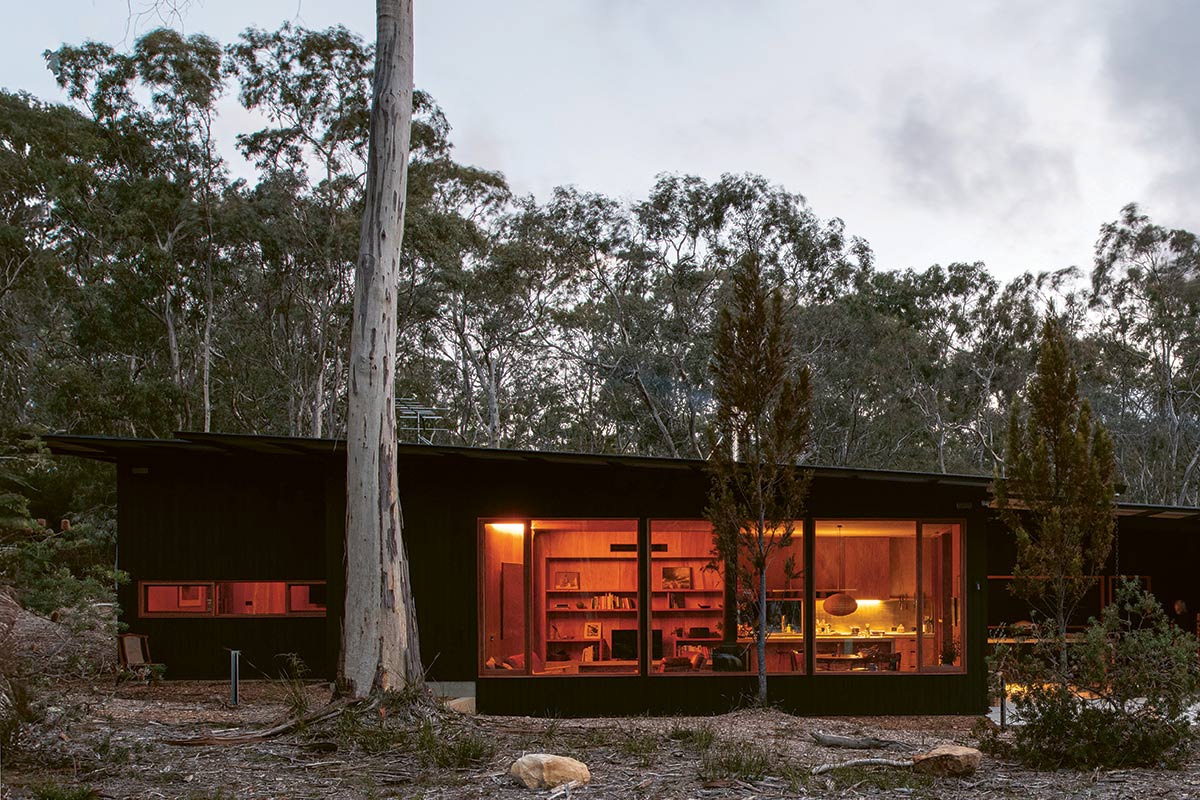
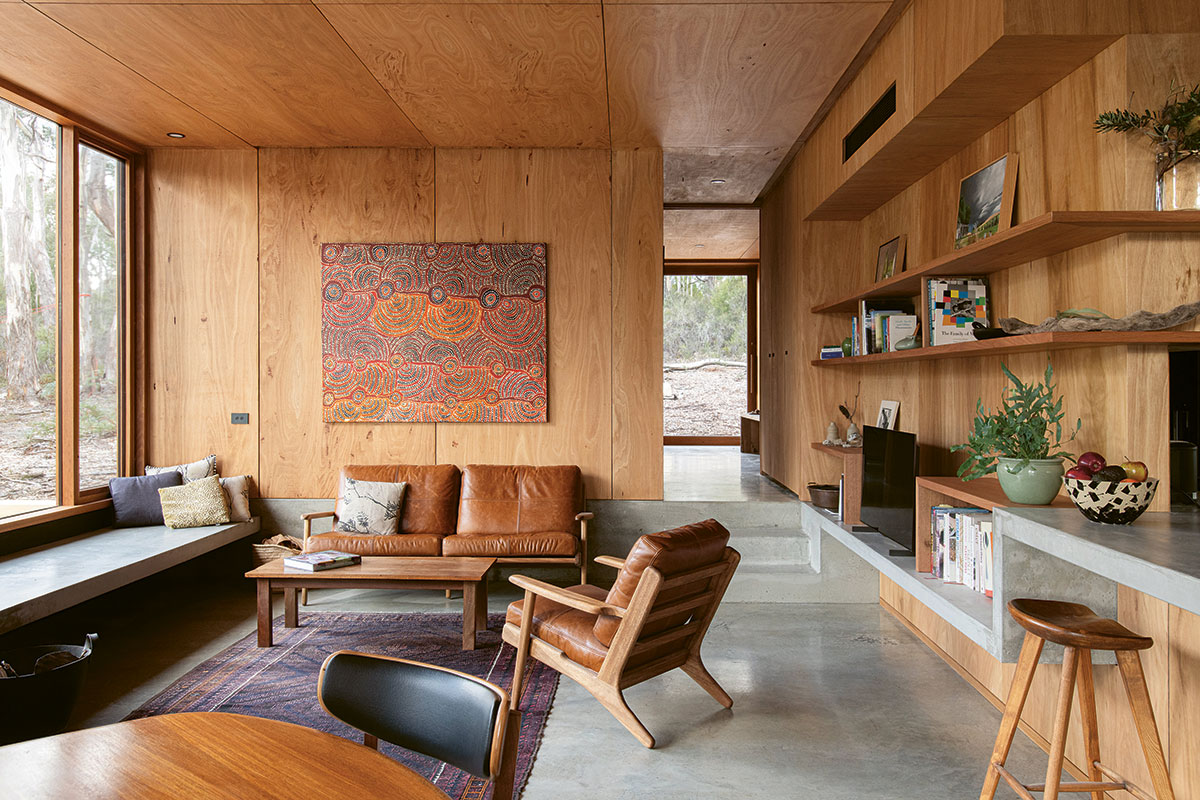
“It’s essentially a small house” he says, with a big overhang, angled for maximum winter solar gain. “Clare magicked the sense of space created by the design, window placement and size, ceiling heights and the feeling of movement and momentum gained by the stairs leading to the bedroom and the external glass door in the bedroom, allowing the view to continue outside to the bush and sky”.
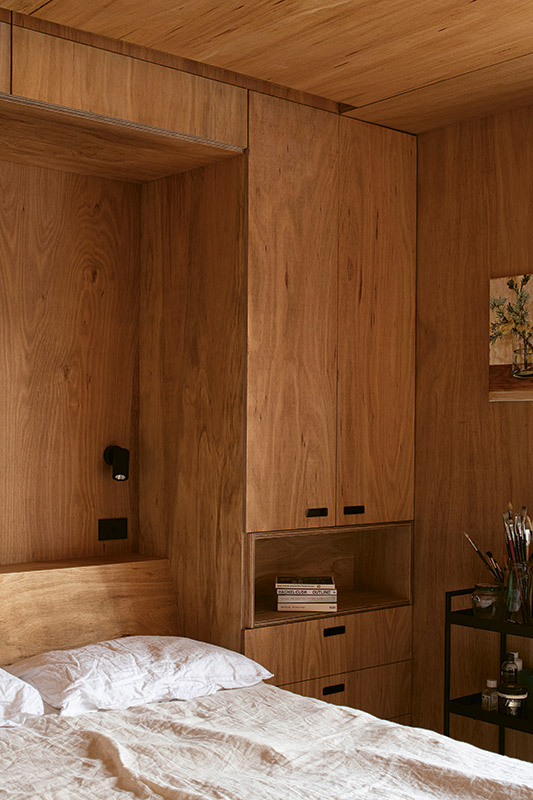
Simon praises the passive solar design as being very effective but adds that the cleverly placed heat pump is also valuable on the coldest mornings when the entire main pod can be warmed by only 15 minutes of operation. The recycled, waste hardwood ply – unpainted, but clear-sealed – was inspired by Cradle Mountain Visitor Centre’s extensive use of plywood (Issue 101). Material simplicity continues with Helen’s choice of pale grey/green subway tiles through all bathrooms and on splashbacks.
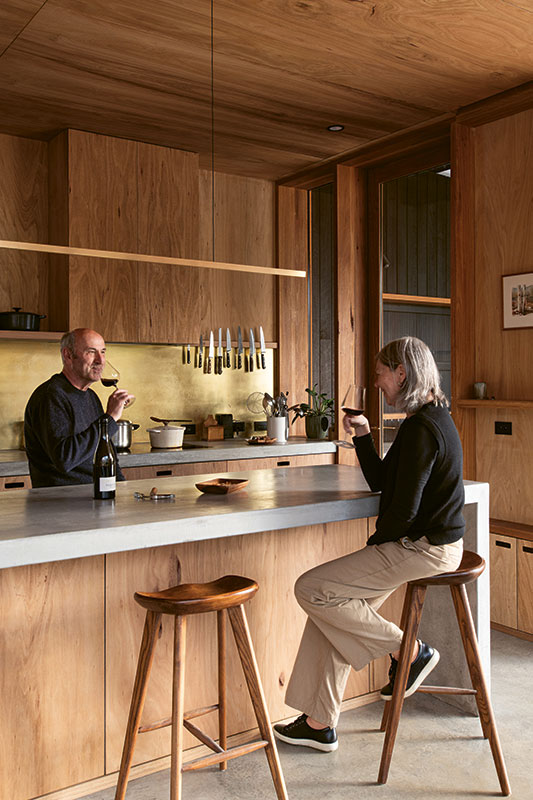
“The sense of space … and the acoustics, make it a generous and gentle environment,” says Simon. “The amount of [windows] brings the outside in, which was something we wanted. It is remarkably practical with storage … yet beautiful.” Pelmet lighting casts a soft glow on the plywood walls, and another nod to Archier is its Highline Pendant installed over the kitchen bench.
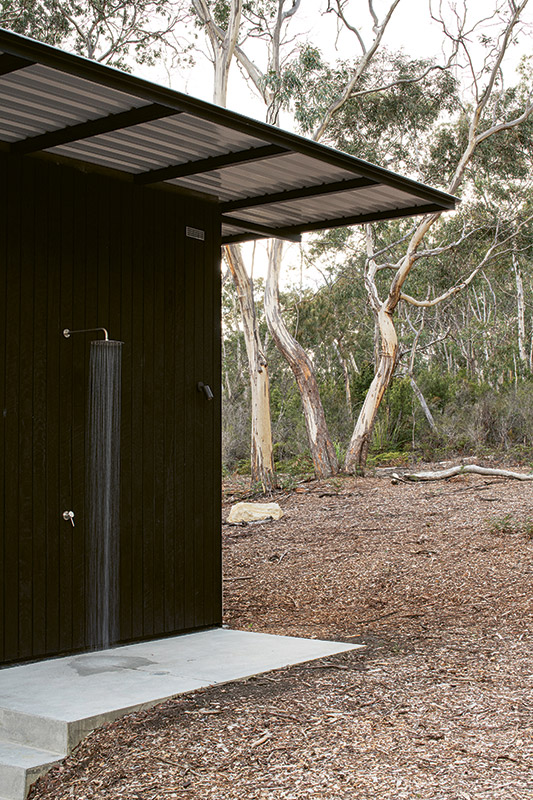
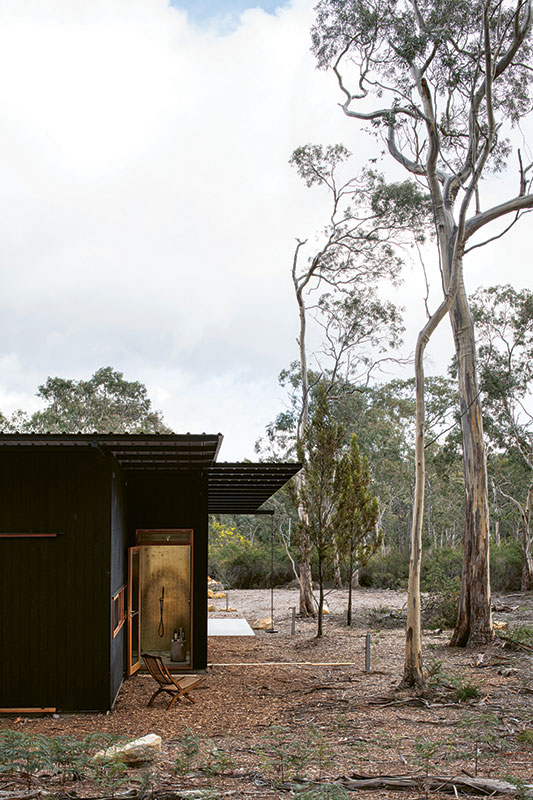
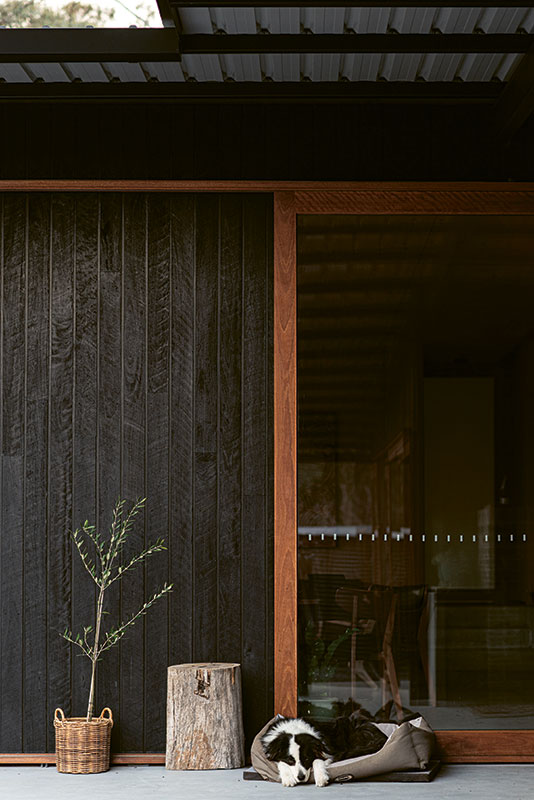
Externally (and inside the covered outdoor kitchen/dining space) the walls are painted black, to reflect the burnt, lower trunks of the endemic silver peppermint eucalypts. Compliance with BAL 29 required a ‘controlled garden’ (close to the house), and that all overhanging branches were removed by an arborist. Simon and Helen initially found the vegetation clearance for the slab disheartening, but they have already started rehabilitating it with low-growing, endemic species that are flourishing. And one of the greatest joys has been seeing so many orchids (black-stripe leafy greenhood, pelicans, waxlip…) appear among the regrowth.
Specs
PASSIVE ENERGY DESIGN
The house is oriented north-east, with all habitable rooms facing this direction. A large eave provides summer shading while allowing winter sun to penetrate deeply into the narrow floor plate and passively heat the internal spaces. Concrete, a thermally massive material, has been used for the floor, bench seats, and kitchen benchtop. When warmed by winter sun, it stores heat and releases it during the evening. Windows and doors are positioned for effective cross breezes, ensuring comfortable living with low energy use all year round.
MATERIALS
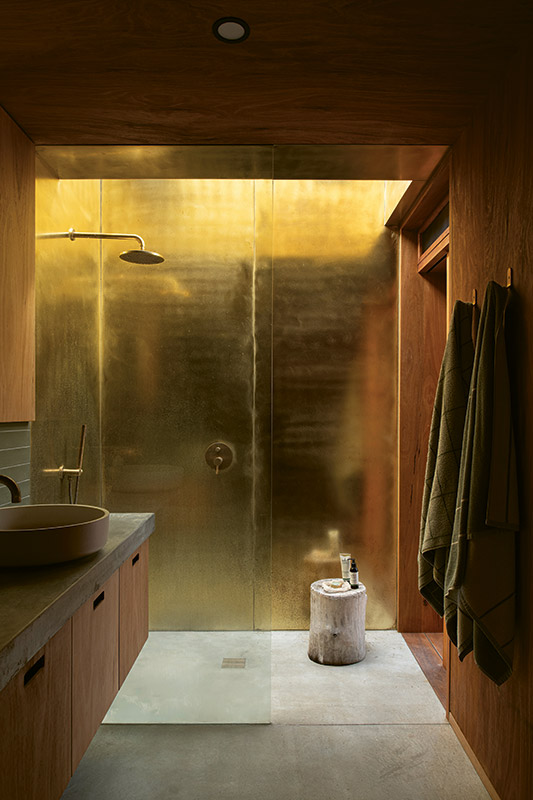
An exposed concrete slab is used throughout the entire house, including steps and outdoor living area. A highly insulated, lightweight, primarily timber-framed with limited steel construction forms walls and roof. Locally sourced Tasmanian hardwood plywood sheets, finished with Osmo Poly-X oil, line all interior walls and joinery fronts. Brass is used in the bathroom and kitchen splashbacks, sanded to a matte lustre finish. External finishes include BAL-rated ironbark timber cladding in a shiplap profile, finished with Intergrain Charred Black stain. Zincalume roof sheeting is fixed to all roof areas and left exposed on the underside to minimise materials.
FLOORING
A durable, clear-sealed concrete floor slab is used throughout, including bathroom floors, which have a grit finish.
GLAZING
Windows and doors, crafted by local joiner Andy Otto, are made from BAL-rated blackbutt timber. The glazing is Australian-made Viridian low-E clear double glazing.
HEATING AND COOLING
Glazing is oriented north-east for optimal winter sun, with external shading provided by the roof overhang. Effective cross ventilation eliminates the need for artificial cooling. In winter, the concrete slab receives ample sun, reducing the need for additional heating from a reverse-cycle air conditioner. A small slow-combustion wood fireplace in the living room provides supplementary heat and ambiance.
HOT WATER SYSTEM
Hot water is provided by a Stiebel Eltron hot water heat pump.
WATER TANKS
Rainwater from all roof areas is directed to a 90 000-litre corrugated Colorbond storage tank, which supplies all household water needs.
LIGHTING
The house utilises low-energy LED strip lighting from Casa Monde in pelmets. ENERGY The house is all electric, and the property is connected to the grid supplied by Tasmanian Hydro.