Cascading Effect – Blue Mountains Home
As a successful test case for the owners’ architectural ideas and research, this mountain home provides a cocoon that goes way beyond aesthetics.
“I’m the most difficult client I’ve ever had,” laughs Ken Yeh, one half – with Carol Marra – of Sydney-based Marra and Yeh Architects as he ushers us out of the lightly misting spring rain into the house the couple designed and built as their own home in the Blue Mountains.
Why the most difficult? Well, not all of it was Ken and Carol’s fault. The early difficulties came with the site itself. Having been subdivided from the neighbours, this slice of steeply sloping land had never been built on but had once been a market garden way back when horses were the main form of transport of fruit and veggies. This meant the soil was full of fertiliser, which is good for veggies, but, if not tended, results in huge weeds. A lot of the work on the site was in taming this wild landscape, cutting the weed growth and planting over 1000 native plants, using special biodegradable mats to stop new weeds from growing. “This was our COVID project,” says Ken. “And we basically had to cover the entire place with a black mat that’s biodegradable. It will be soil in three years.”
Another reason for the ‘difficulty’ was Carol and Ken’s determination to use new or unusual building technologies as a testing ground for future projects. The first of these, which they discovered designing a solar farm in Malaysia, was a screw pile foundation called Krinner Ground Screws that replaces the need for a concrete slab, instead using screws to anchor and elevate the home. “You don’t have to dig trenches. You don’t have to dig holes,” says Carol. “What a great technology. They came and got the whole job done in one day.” Ken adds: “Eight hours, with only two people, a father and daughter team.”
The second was a prefabricated flooring system made of steel, constructed off site meaning assembly was super quick. Mesh all around the undercroft of the house also reduces the risk of embers entering and setting the house ablaze. Other niche construction materials included thermal clay balls, first developed for the lunar landing module, that retain and release heat slowly. “We research these things, follow them through their technological development, and then we say, okay, are they affordable?” says Ken. This includes intumescent paint, which they used on the home’s metal structure to create a protective barrier from fire … did I mention that the house was built during one of the worst bushfire seasons in Australia’s recorded history?
The presence of that fire, which burnt 24 million hectares of land (about the size of the UK) between June 2019 and March 2020, meant the early weeks on site and living in the house were filled with thick smoke. “It looked like a volcano,” says Carol. “Some mornings, you’d wake up, go on the deck and there’s a charred leaf,” says Ken. So, even though they are on the lower end of the BAL fire zone rating at 12.5, the couple decided to go above and beyond with fire protection to a combination of BAL 29 and BAL 40.
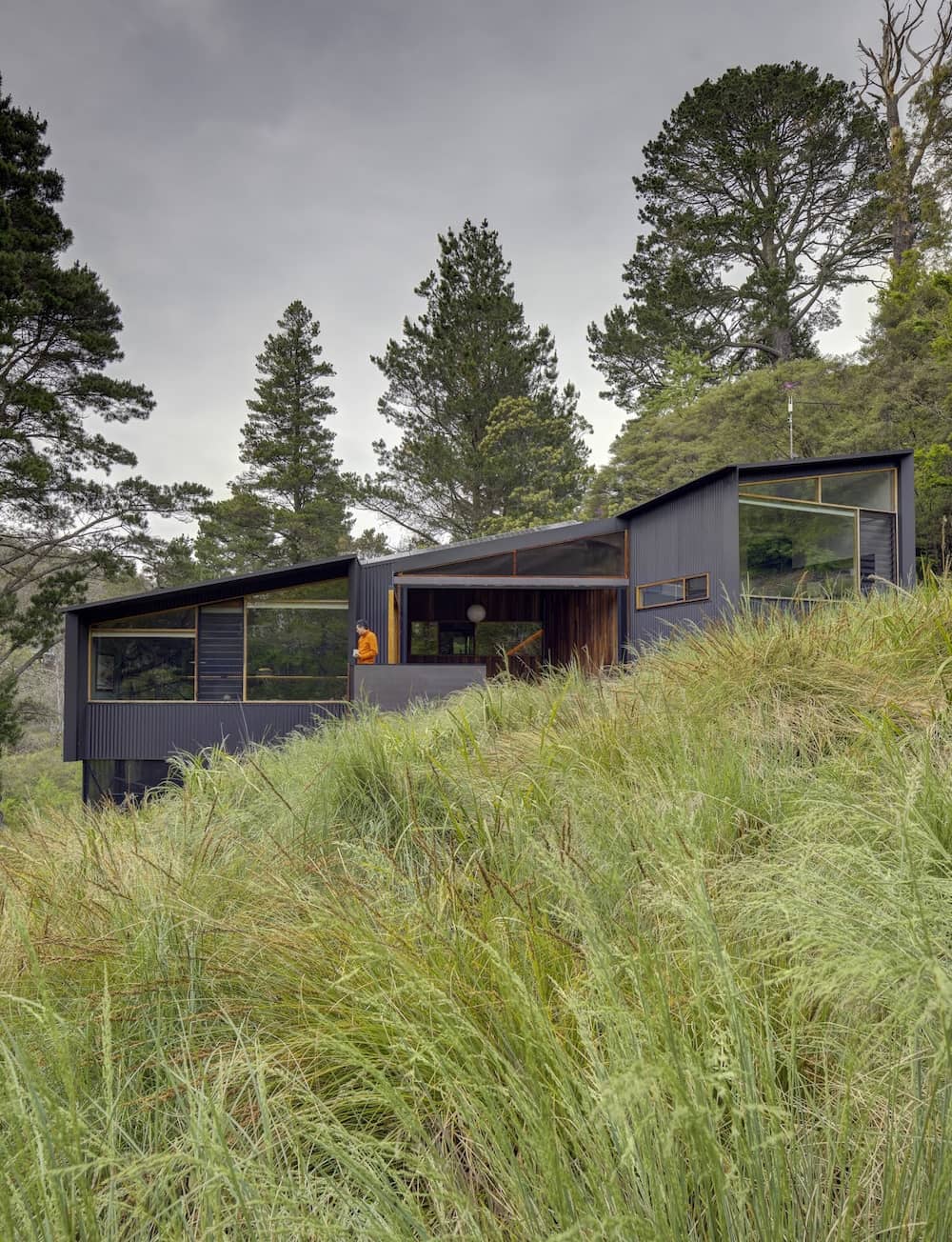
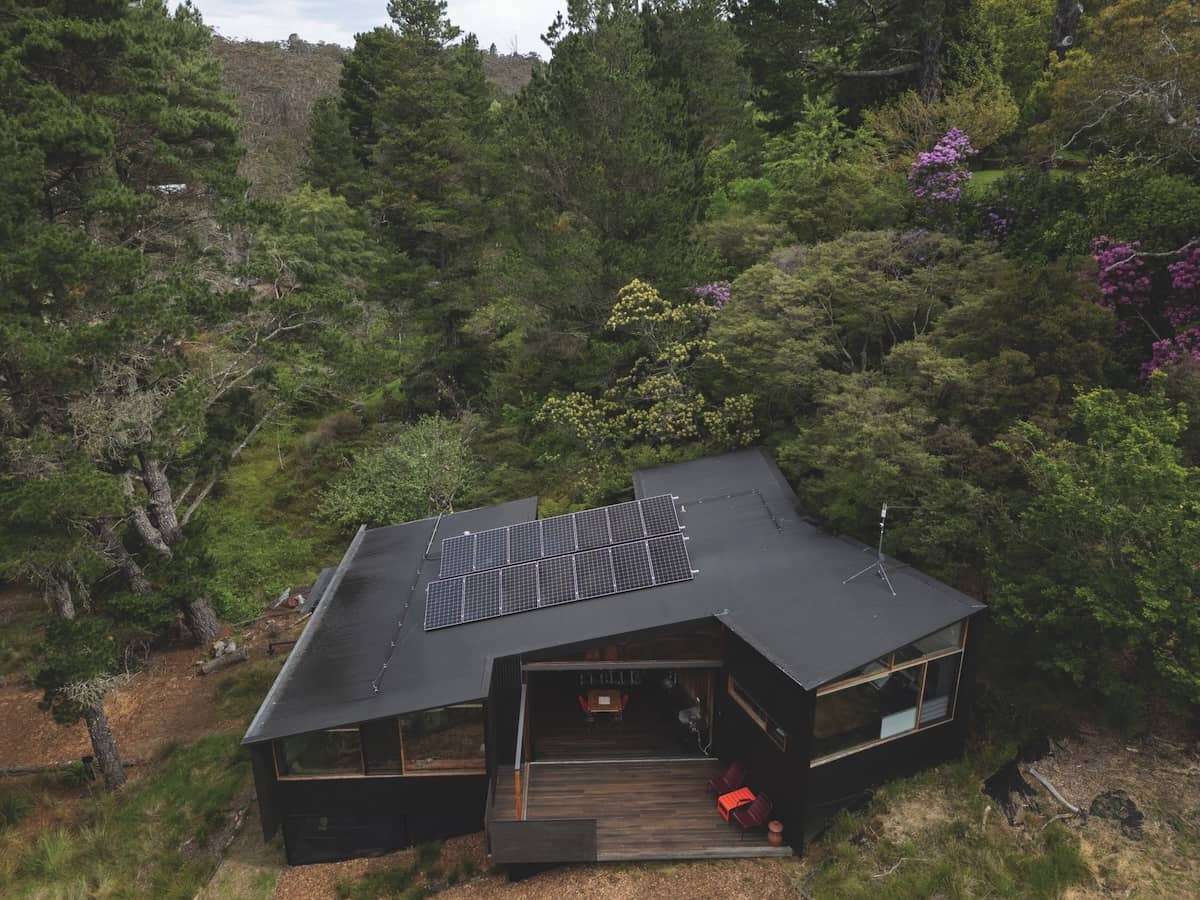
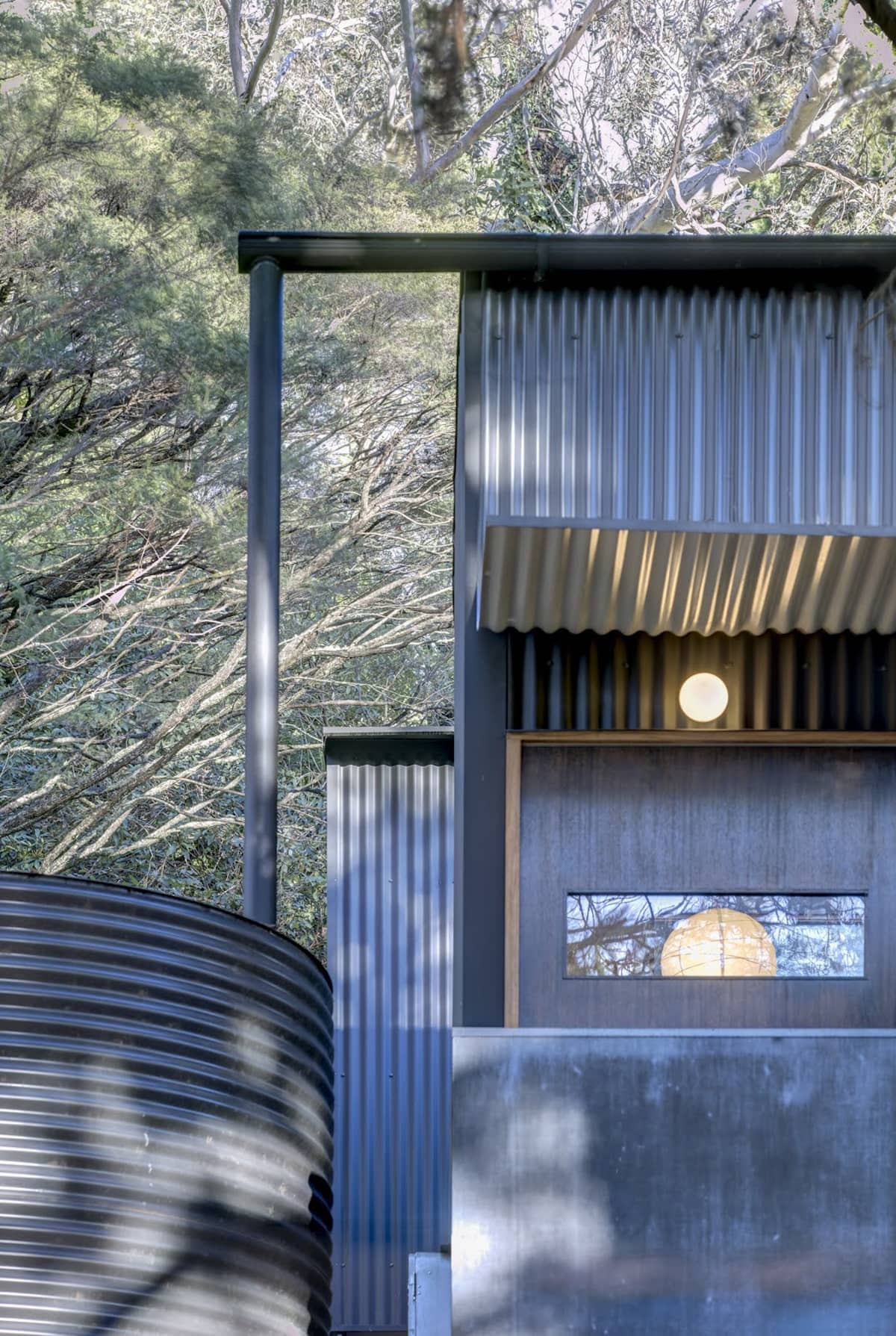
This includes a sprinkler system fed by the rainwater tank, which is topped up by mains water with the runoff going straight back into the tank so no drop is wasted. The roof is angled for this purpose, and the sprinklers are also operated remotely so they can be turned on and off even if no one is at the house. The position of the home on the site was also designed around potential bushfires – placing the house lower on the slope means that if the neighbouring houses catch fire up the hill, there’s a fire break.
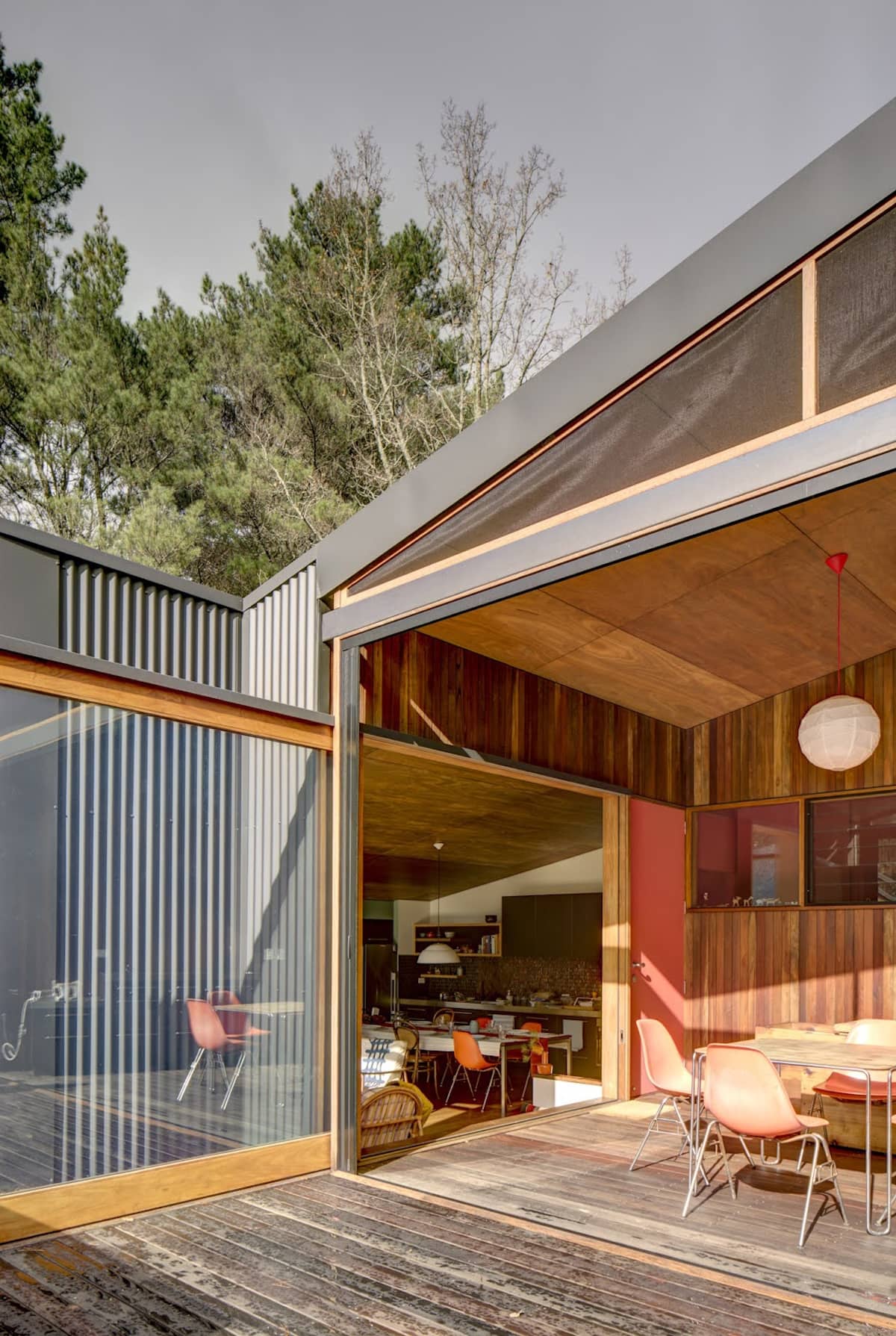
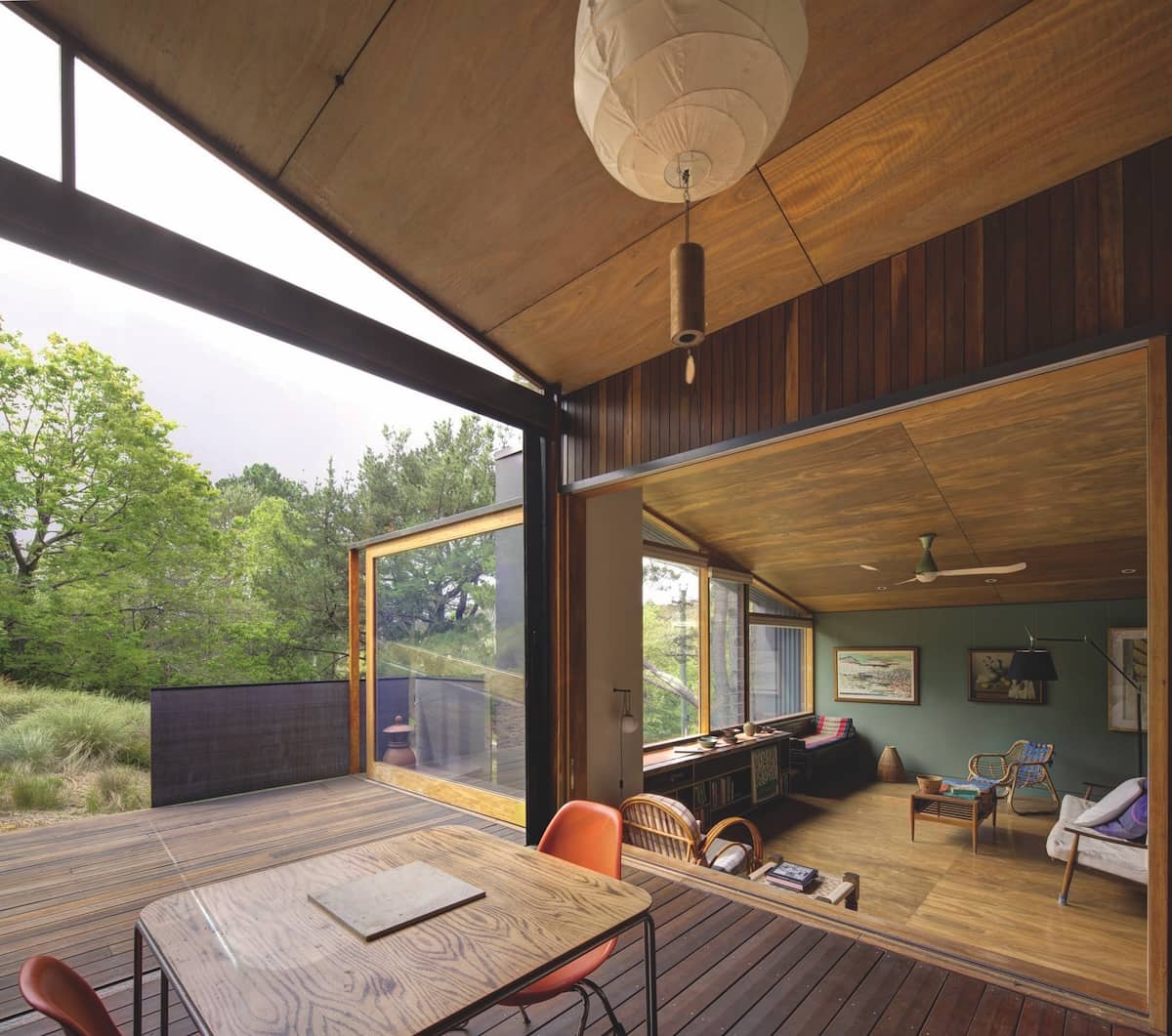
This site positioning also means that winds flow over the top of the building, creating a shelter. The front door is at the bottom of the slope, where you enter first into a mud room, both lower and cooler than the rest of the house, and hang your coat and take off your shoes, switching to house slippers. Up a few stairs, the house opens out into the main living space, with open kitchen, dining and living space. Windows allow in northern sun, helping to keep the room warm and provide views of the garden. A set of stairs connects this part of the house to the other wing, which is pivoted slightly forming an exterior deck in between that is sheltered from wind and rain. Both the layout of the house and its acoustic and thermal separation are flexible, allowing the couple and their frequent guests to both live and work apart, and together.
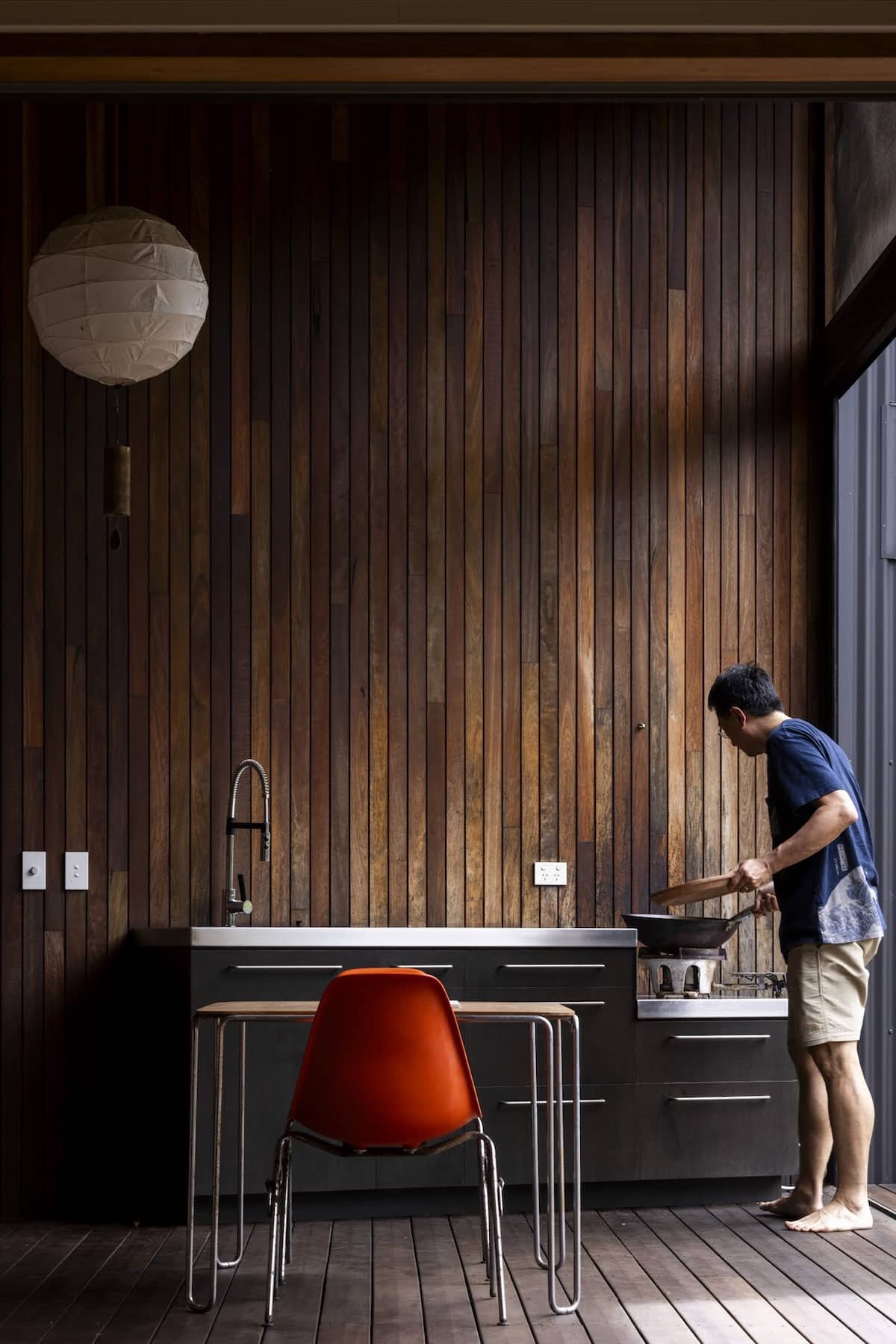
Upstairs, there are two bedrooms and a large office space where Carol and Ken run their architecture practice while at home (the main office is in Darlington, Sydney). The guest room next door opens out with two large doors to the office space in case more room is needed for a sleepover. During summer, the deck can be opened up to the living space or the garden, depending on what’s happening. “Being able to make a smoky mess with the wok is a joy,” says Ken. “We have what they call an outdoor kitchen.” Carol adds: “We had a former client, they’ve got three kids and they came to stay for a weekend. The kids slept on the deck in sleeping bags … there was lightning … they loved it.”
The house is carefully thought-out and beautifully rendered with an Australian flavour that is also distinctly international – originally, Ken is from Malaysia and Carol from Argentina, and they met as architecture students in Texas. But it is also an example of iterative research-based practice, informed by the pair’s research, teaching and Carol’s recent Churchill Fellowship which detailed building case studies for flood, fire and other emergencies (it’s on the Churchill Fellowship website and definitely worth a read). And it turns out that putting research into practice in a family home as lovely as this one is the best of all worlds.
This site positioning also means that winds flow over the top of the building, creating a shelter.
Specs
ARCHITECT
Marra+ Yeh Architects
LOCATION
Dharug Country / Leura / NSW
PASSIVE ENERGY DESIGN
The home is oriented to the north and north-west with large, double glazed windows allowing the sun to enter the home during winter for an extended period of time. Thermal inertia is created using phase change material (BioPCM) located above the ceiling lining. In winter, the PCM absorbs heat during the day and releases at night, resulting in free heating and a more stable indoor temperature. The reverse happens in summer when the PCM is cooled at night through night flushing and absorbs heat during the day keeping the indoor spaces cool and comfortable. As the prevailing winds are from the west, the home is protected from the cold westerlies which pass over the home with some velocity. Effective cross ventilation is achieved by creating a Venturi effect – the central circulation spine squeezes air through the building, with operable windows in every room ensuring air flow to all spaces.
MATERIALS
The home is constructed with lightweight materials (timber and steel), to facilitate minimally invasive foundations on the sensitive hanging swamp it sits on. The flooring system is prefabricated light-gauge steel flooring designed and constructed off site and swiftly assembled on site minimising construction waste and providing additional fire resilience. The entire construction is clad with corrugated Colorbond, a maintenance-free non-combustible material and was awarded the 2025 AIA Colorbond Steel Award. Steel has been used where the structure is at high risk of climate impacts and, in lieu of concrete, achieves an acceptable balance between embodied carbon and resilience. Environmental Product Declaration for the steel products indicates an average of 24 per cent recycled and recovered content with the steel components reducing the overall cost, providing longer durability and, working in combination with passive and active design measures, contribute towards fire resilience to achieve an overall BAL 29 rating with specific components upgraded to BAL 40. Over 90 per cent of materials are locally sourced.
FLOORING
The floors are 15-milimetre FSC-certified eucalyptus plantation plywood flooring from Big River Timbers over multiple layers of insulation.
GLAZING
Timber-framed, double-glazed, low-E windows with a SHGC of 0.26 (a measure of how freely solar heat passes through a window). North facing glass is protected by eaves and calibrated to be shaded during the short summer season (December to February), noting the climate in the mountains often has single-digit days and nights even during the summer months making solar access more important than shading. Internal insulated honeycomb blinds from Veneta are used for light and glare control.
HEATING AND COOLING
Heating during winter is mainly provided by the sun via the large, north facing double glazed windows and doors. During inclement weather, an electric heater is used. Cooling is through opening well-located windows on the east and west façades that induces the Venturi effect. Each room also has a ceiling fan.
HOT WATER SYSTEM
Hot water is provided by a high-performance electric Sanden heat pump with a vacuum insulated tank. It is powered by a 5.6kW photovoltaic system.
WATER TANKS
A single 10 000-litre water tank (Kingspan Water Tanks) collects 80 per cent of the water coming off the roof. During a fire, when the roof sprinklers are switched on, approximately 40 per cent of the water is recycled back into the tank, allowing the sprinklers to run for extended time periods.
ENERGY
A 5.6kW grid connected solar PV system with 30kWh battery and whole-of-house back-up.
Relevant Designbook Suppliers