Assemblage – Bruny Island Joint-Owned House
No doubt there are easier ways to make a house on an island off an island off an island. But it certainly wouldn’t be this one.
Bruny Island (lunawanna-alonnah) is only 15 minutes by car ferry from Kettering, but as soon as wheels make landfall it feels one thousand miles away. There are two parts to Bruny, north and south, separated by the narrow isthmus of Bruny Island Neck. Here, the Truganini Lookout affords 360-degree views over the island, including Simpsons Bay to the west, and maybe the sighting of a Little Penguin, or two.
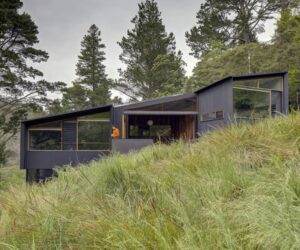
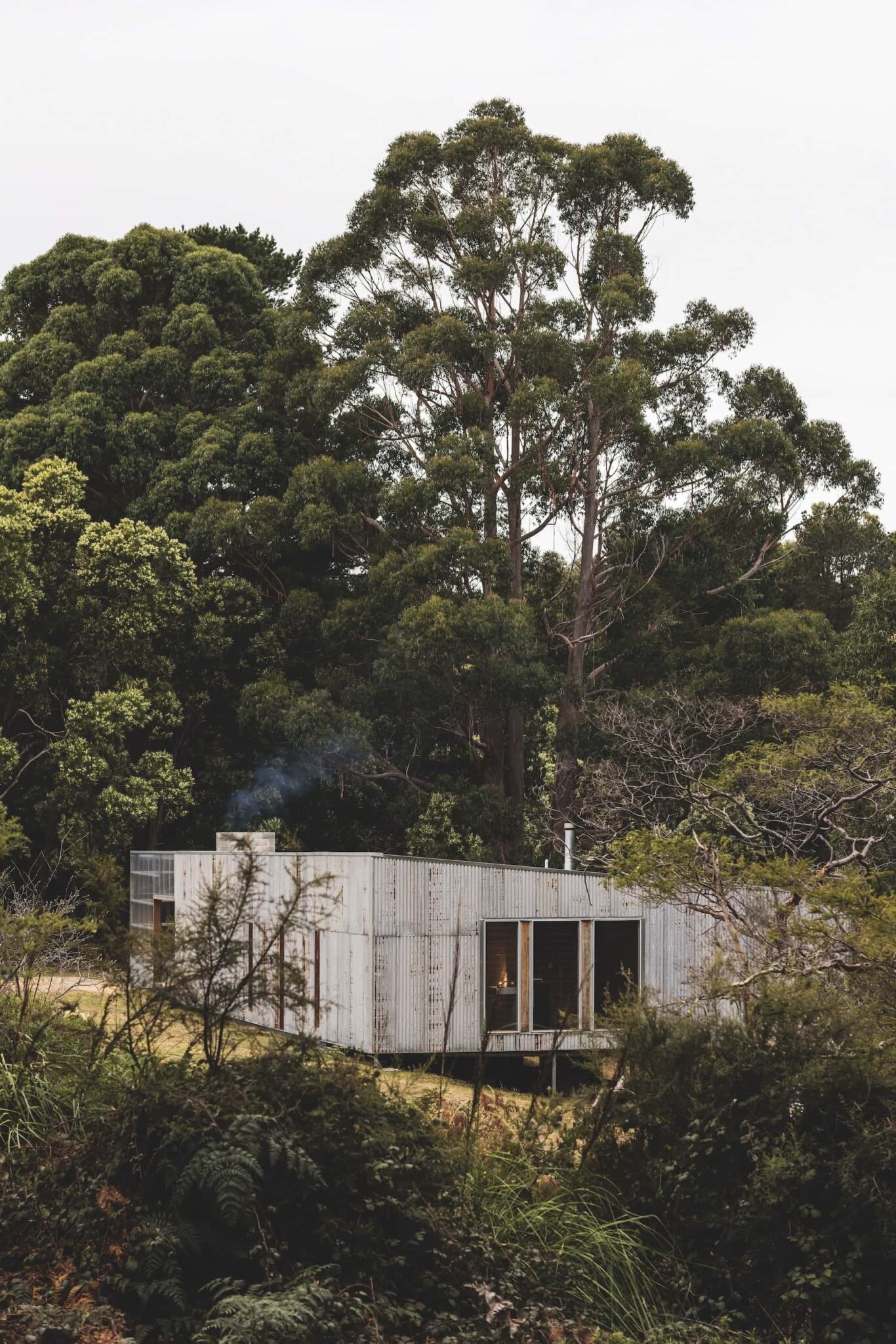
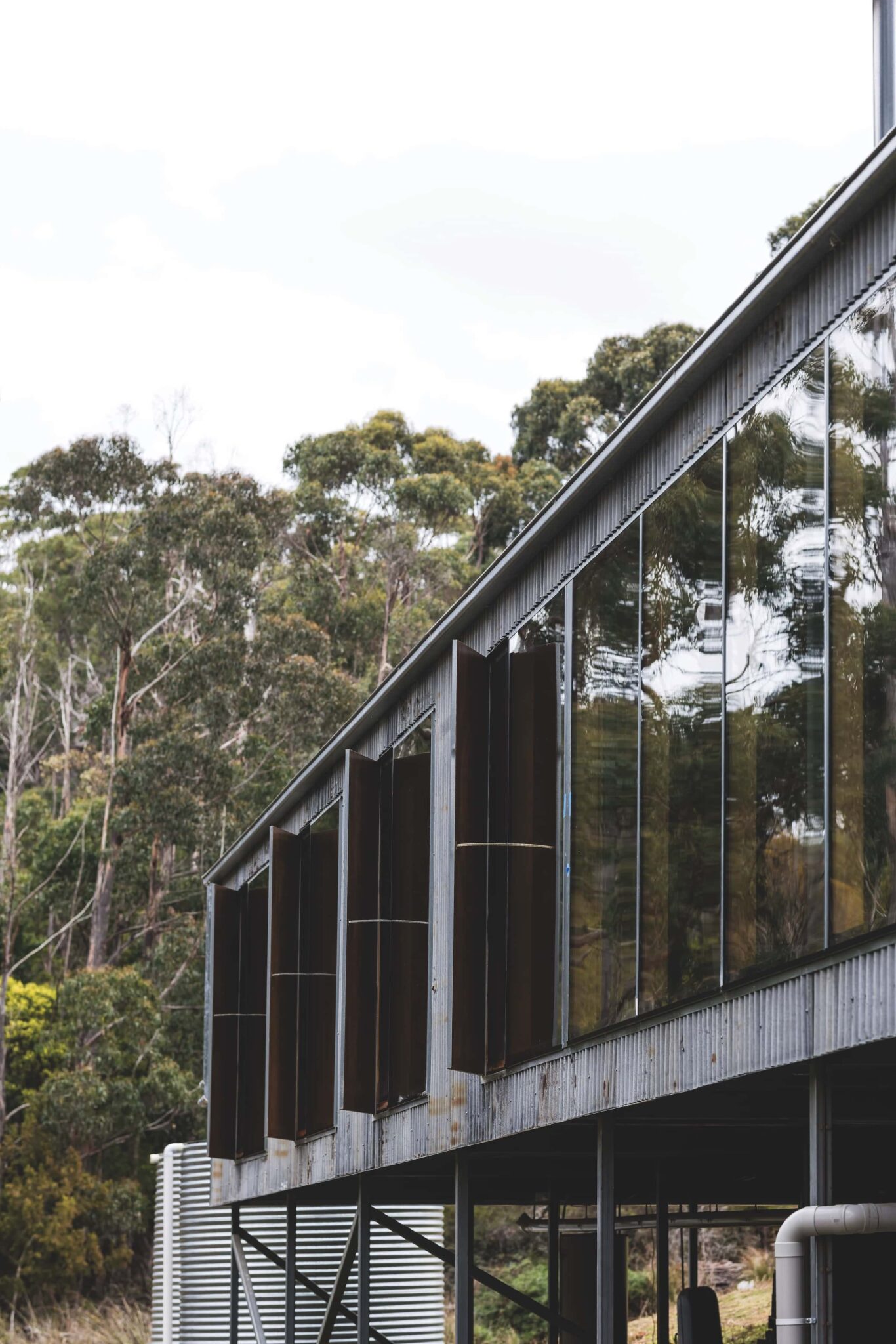
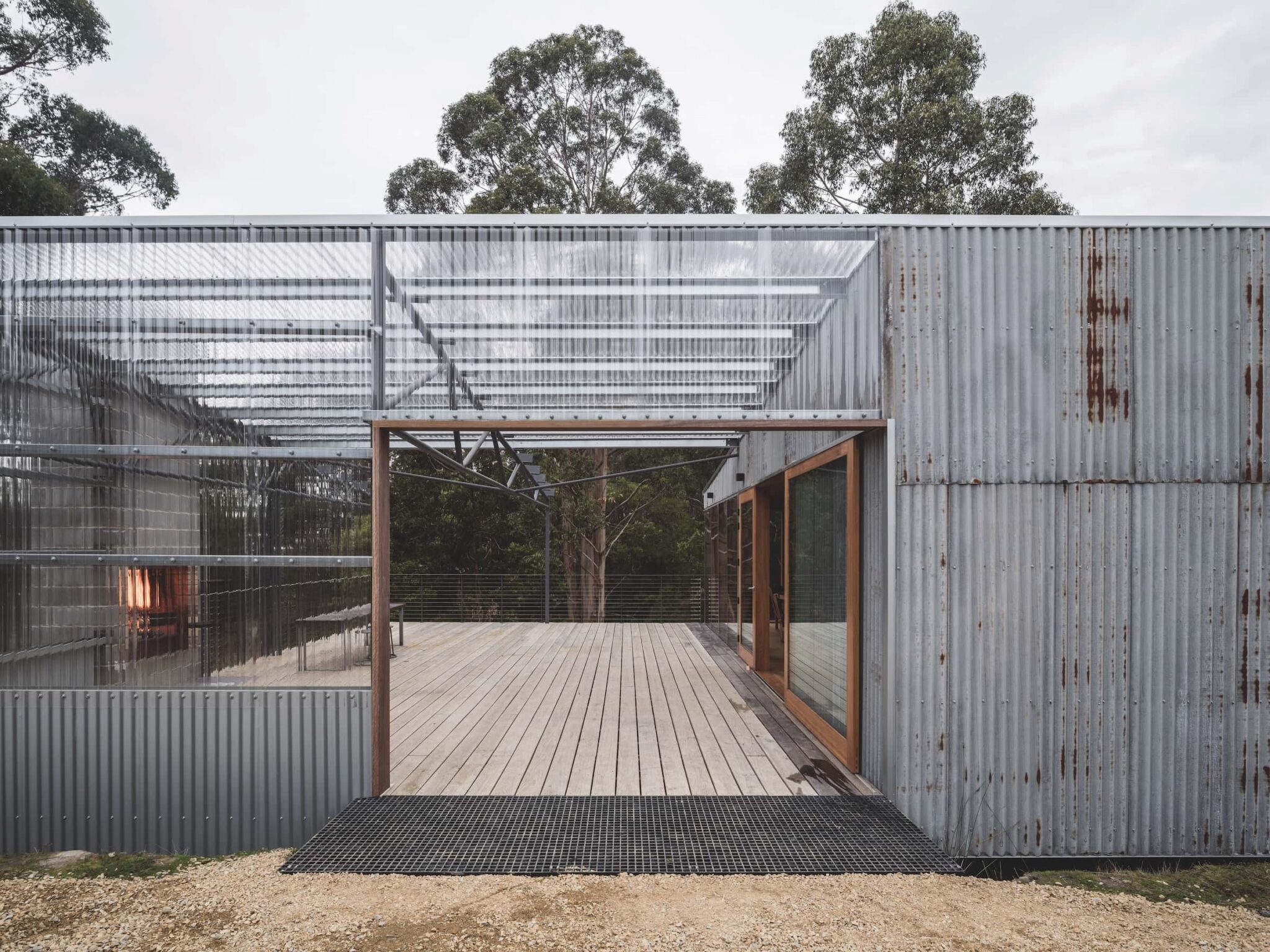
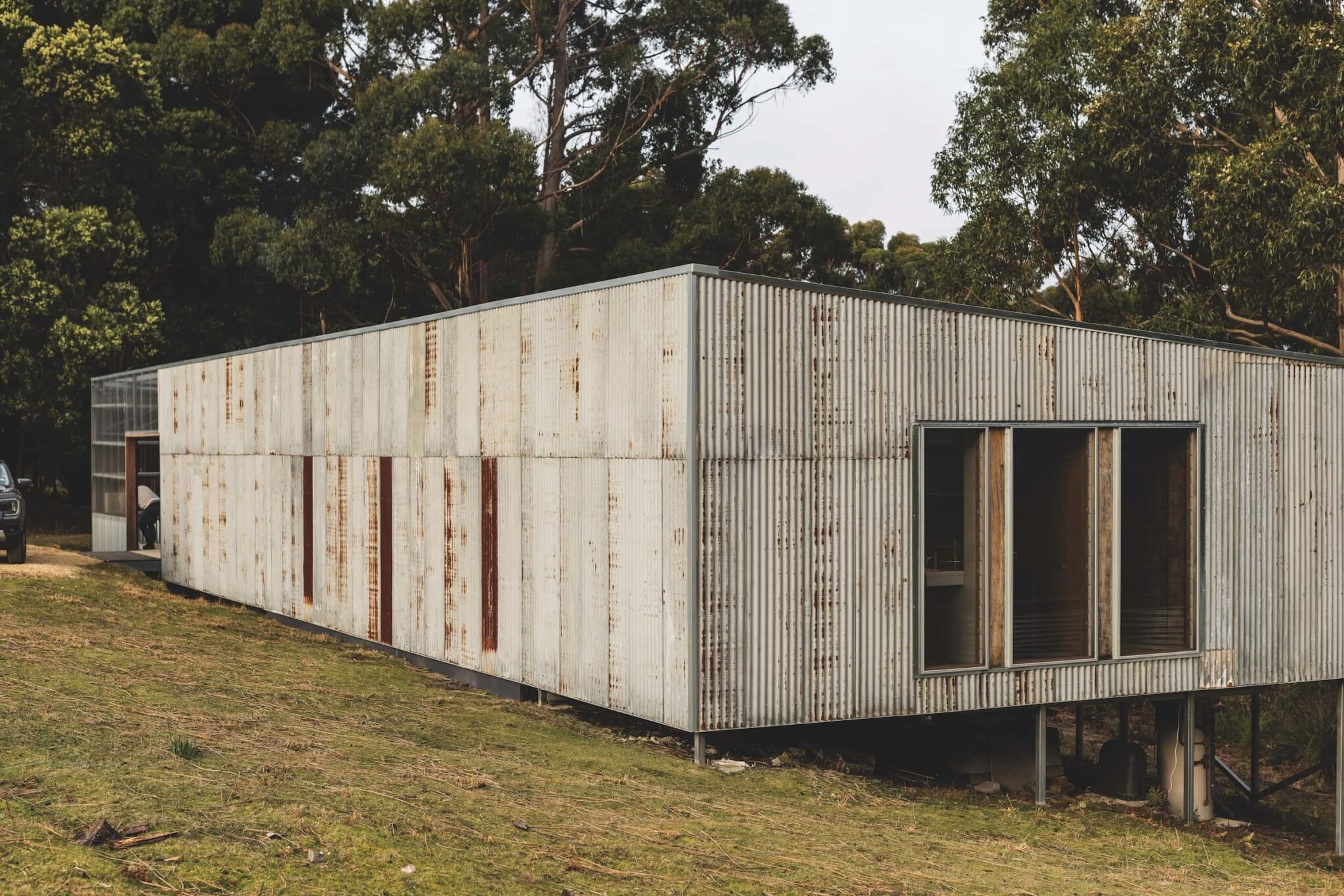
It is here that architects Richard Loney and Richard Brenchley from Dock4, along with Giles Newstead from Mana, designed the house on Simpsons Bay Road, on land owned by all three. To reach the house, the road continues along the Neck, then cuts back sharply to loop around to Simpsons Bay. On the route are shearing sheds, tilting wooden barns, netted cherry orchards and remnants of apple farms. So, on arrival, the exterior of the house already seems familiar, as two rows of newly planted quince trees herald the site, and the building’s façade is a stretch of weathered, corrugated iron.
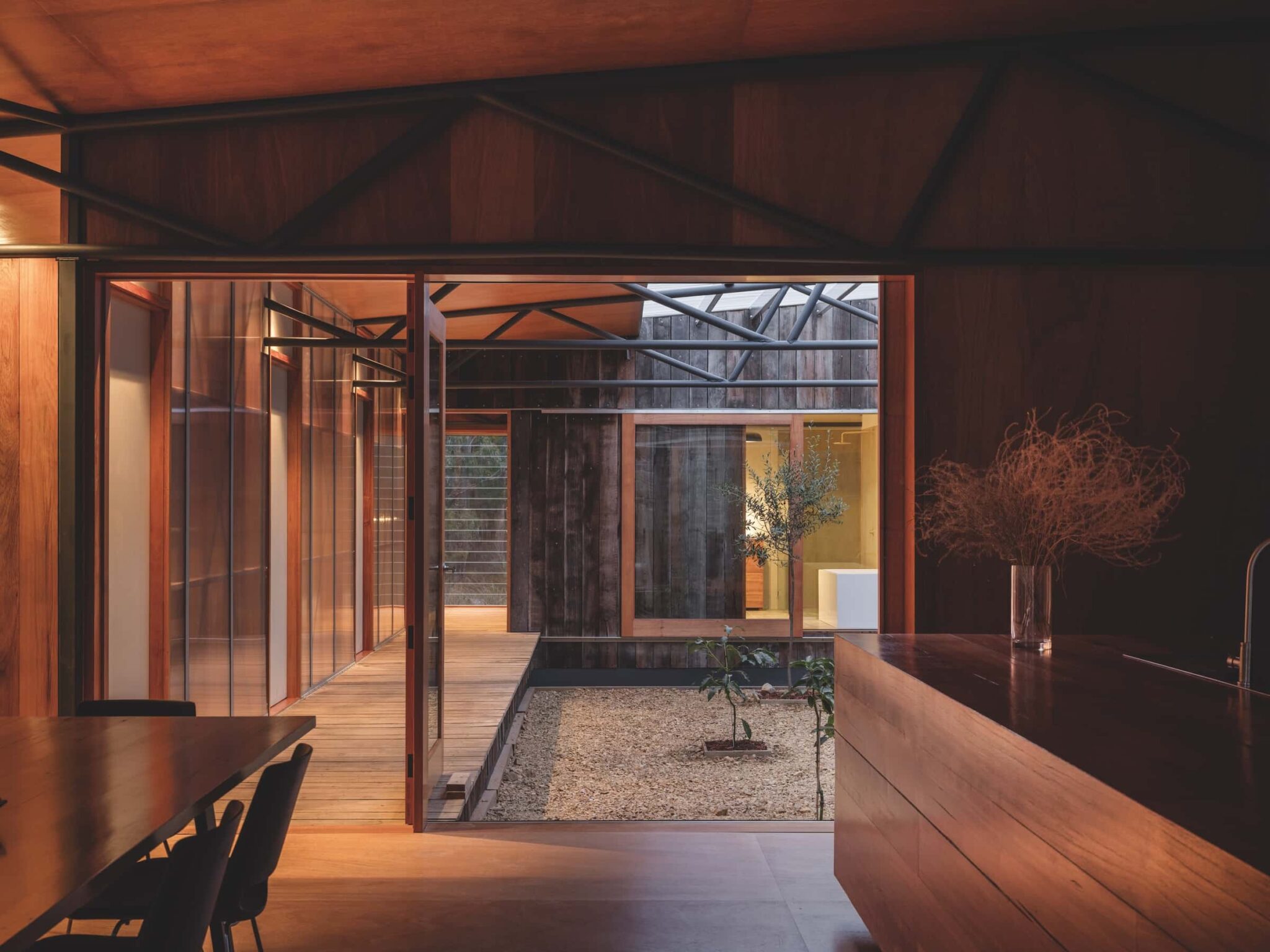
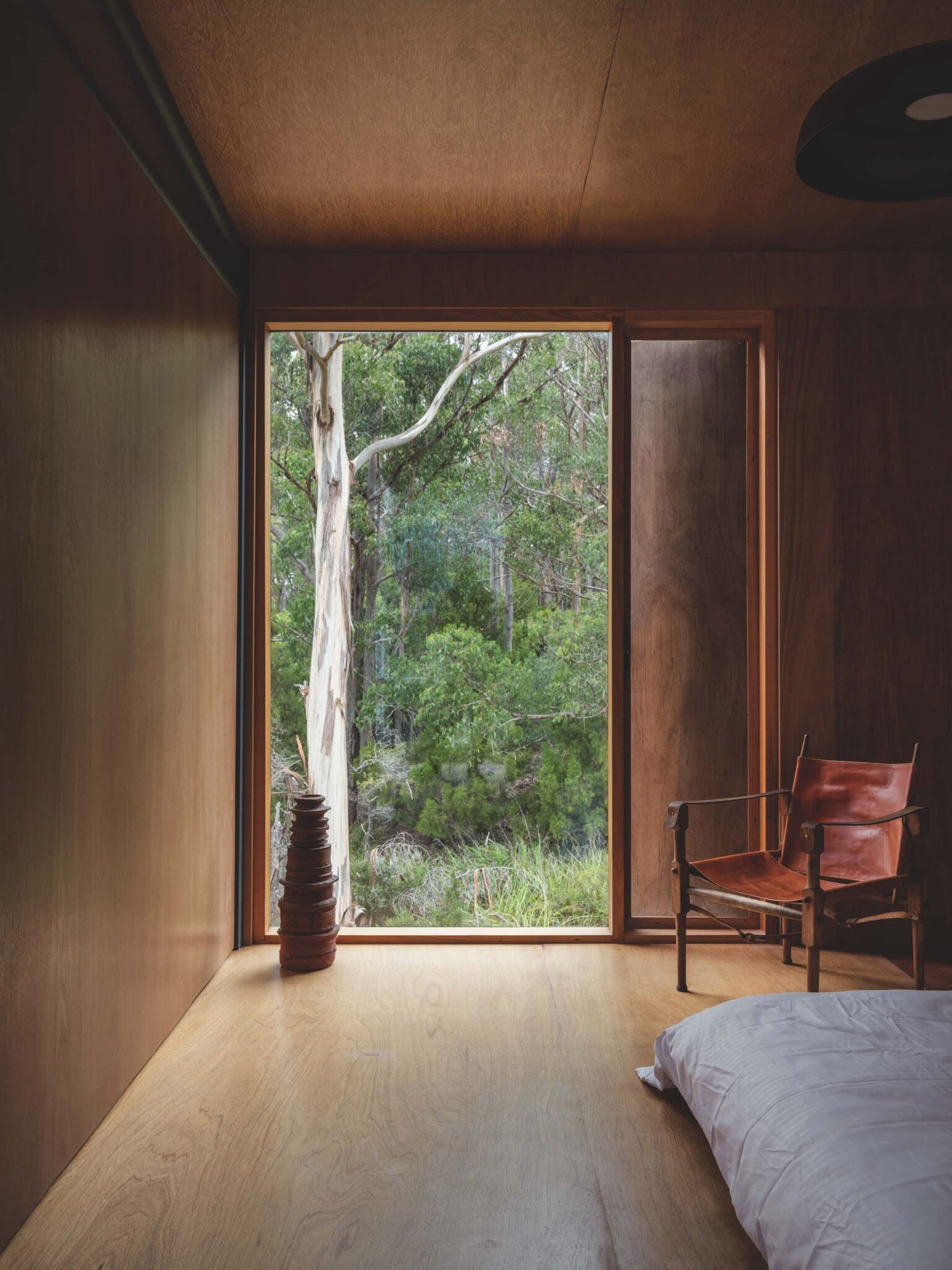
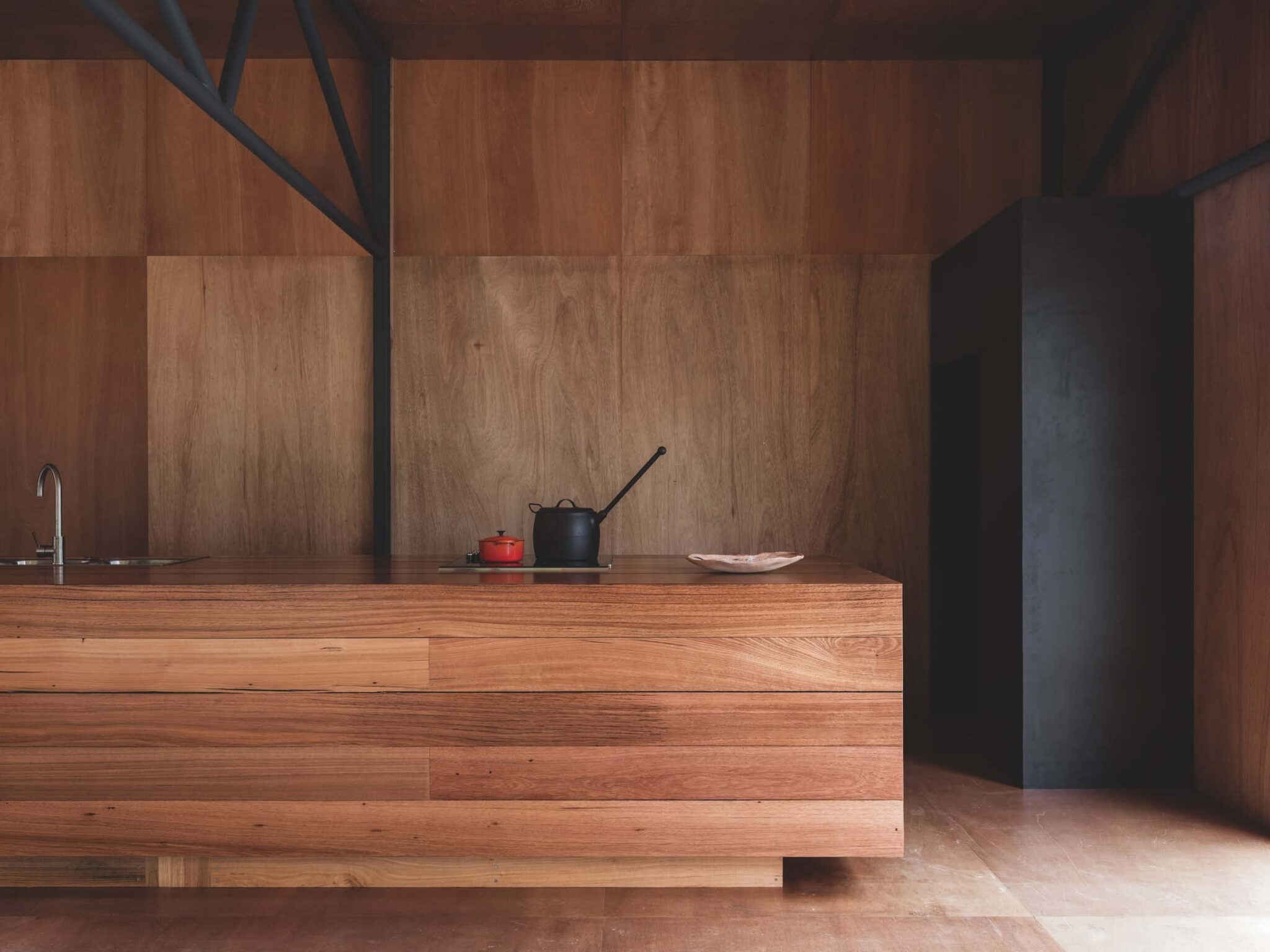
The house’s dimensions were largely determined by the materials the architects had to hand, following their design of two residential structures to replace an un-saveable mechanic’s workshop in North Hobart. The salvaged steel trusses from the workshop were repurposed and left exposed inside the house and over the large deck. Corrugated iron sheeting from the workshop roof screens the internal courtyard, and the kitchen and bathroom, which are lined with marine ply and insulated.
Salvaged workshop materials used throughout also include hardwood rafters, floor joists and boards, still with traces of the stains from many engine oil changes. Other building materials had been rescued earlier from 10 Murray Street (the former State Offices building in Hobart), when it was demolished as part of the redevelopment of Parliament Square. The house, designed through reassembly, could also be readily disassembled for use elsewhere; although Richard Loney hopes this never occurs, as he sees the house, wedged between stands of tall eucalypts with a view though to water, as being “so right” for this site.
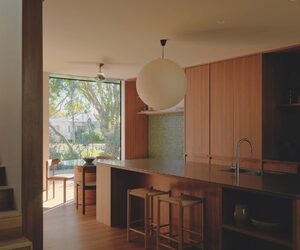
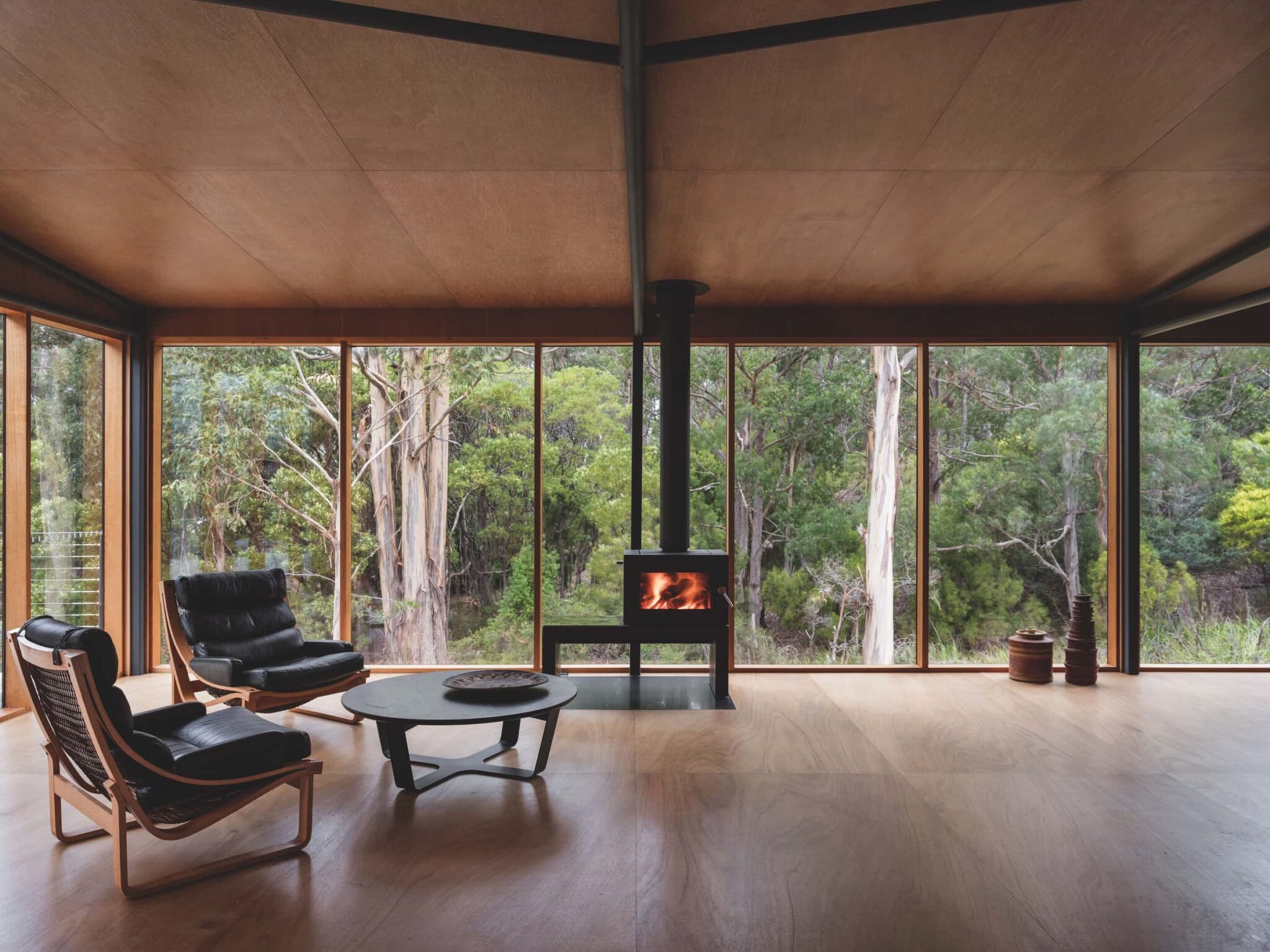
The layout is simple: entry is across the deck into the large living space, on one side of which is a kitchen with a large central bench with a lot of storage space. The kitchen has a gas stove, yet Richard says most of the cooking is done on the wood stove on the deck, all year round. The living space opens by sliding door into another neutral room which could be a study, library, separate dining/meeting or fourth bedroom. The three bedrooms behind are each accessed from a central walkway, with the internal courtyard opposite. Behind the courtyard is a bathroom, with toilet and deep bath, and a second toilet sits tucked into its own nook, at the end of the walkway. In summer, most of the living takes place outside, on the house-width deck, protected from western sun and cooled by bay breezes.
The 10-metre-long internal courtyard hosts several flourishing avocado and citrus trees, with buried irrigation. Corrugated polycarbonate sheeting above the courtyard ensures the temperature inside is warm through the winter and surprisingly cool in summer, particularly when the louvred windows at the western end are opened, and breezes from the bay are also pulled through the house. Although there is a large wood heater in the living space, no additional heating of the individual bedrooms is required in winter, says Richard, as each open to the warmed courtyard, and the house is well insulated by wool batts.
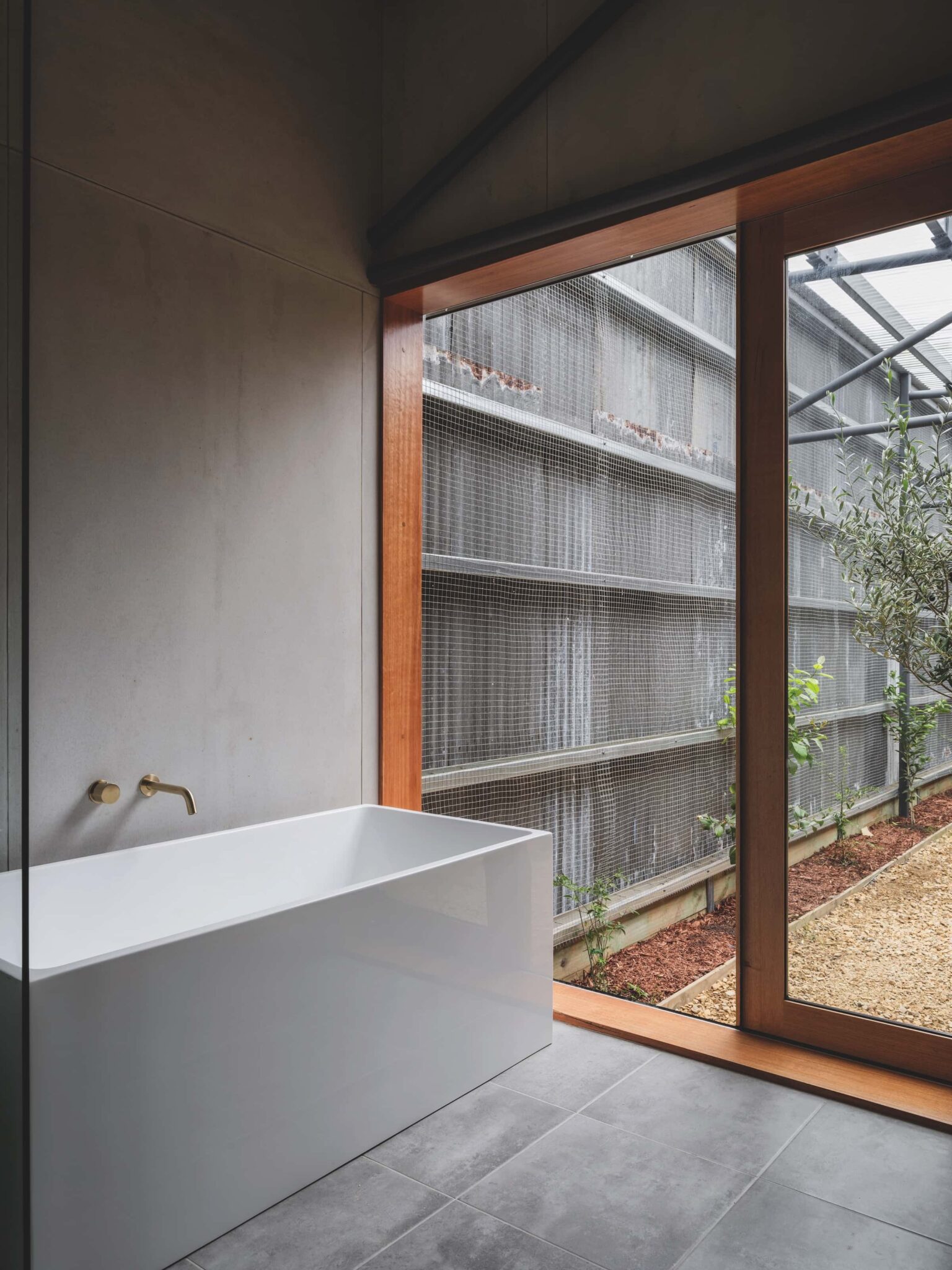
Materials and functions are consciously left exposed (no need for concealment, and this also saved building costs). Batts are visible through polycarbonate walls, the concrete sheeting in the bathroom is sealed but left uncovered, and children enjoying the bath after a day of salty swims can be monitored through a large window into the courtyard. Richard notes the look of the house is deliberately unfinished as part of the design ethos but it also possesses a calm, quiet elegance.
Astrid, the protagonist in Heather Rose’s 2019 novel Bruny sums up island living: “… to live on an island isn’t just a location … it’s a choice to be remote”. With remoteness comes positives and negatives; one of the latter can be the difficulty of transporting masses of building materials. On the other hand, the sense of being removed from urban stress can be profound. At Simpsons Road, the hard work of transporting and reconstructing recycled building materials has resulted in a minimal, comfortable and very beautiful living environment.
“… the look of the house is deliberately ‘unfinished’, as part of the design ethos, but it also possesses a calm, quiet elegance.”
Specs
ARCHITECTS
Dock4 Architects
LOCATION
Nuenonne Country / Bruny Island / Tas
PASSIVE ENERGY DESIGN
The house is mostly oriented to the east and north with glazing to the ground floor living area. In winter the sun can penetrate well inside the living room. The internal environment is moderated by an enclosed green courtyard, maintaining constant temperatures year round. Windows and doors are positioned for effective cross breezes. The design provides comfortable living with low energy use year round.
MATERIALS
The ground level has a lightweight timber floor, and the main volumes are highly insulated, with a lightweight steel (recycled) and timber framed construction. The interiors feature recycled expressed steel trusses, recycled wall cladding, marine plywood sheeting to the ceilings and some walls and clear Danpal Double Wall polycarbonate sheeting to internal bedroom walls facing the courtyard. A tung oil finish is used for bedroom and bathroom joinery. External finishes include recycled iron roofing, recycled hardwood cladding and polycarbonate sheeting. A mixture of Zincalume and polycarbonate roof sheet is fixed to all roof areas.
FLOORING
Clear-sealed marine plywood flooring on ply sheet underlay.
GLAZING
Window and door frames are all recycled hardwood with Viridian low-E clear double glazing and Breezeway louvre inserts and awning/casement windows.
HEATING AND COOLING
Glazing is oriented north and east for winter sun and in summer the steel-framed pergola supplies shading to the deck and living area. Effective cross ventilation removes the need for artificial cooling. In winter, the entire house is heated by a small slow combustion wood fireplace in the living room and the greenhouse effect of the central courtyard. The courtyard is both a circulation space to the bedrooms and bathroom, and also a green space that moderates the temperature differential, allowing for the growth of productive semi tropical plants and a temperature stable indoor/outdoor space.
HOT WATER SYSTEM
Recycled commercial Hot Water Cylinder system.
WATER TANKS
Rainwater from all roof areas is directed to two 15,500-litre above ground galvanised tanks, which provide water for the entire house.
LIGHTING
The house uses low energy LED lighting supplied by About Space Lighting.