Flame Trees – Amongst the Eucalypts
The architectural demands of responding to bushfire attack levels often result in a path of least resistance. But leaning into the problem can produce startling results.
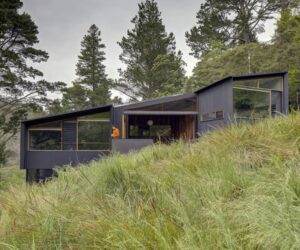
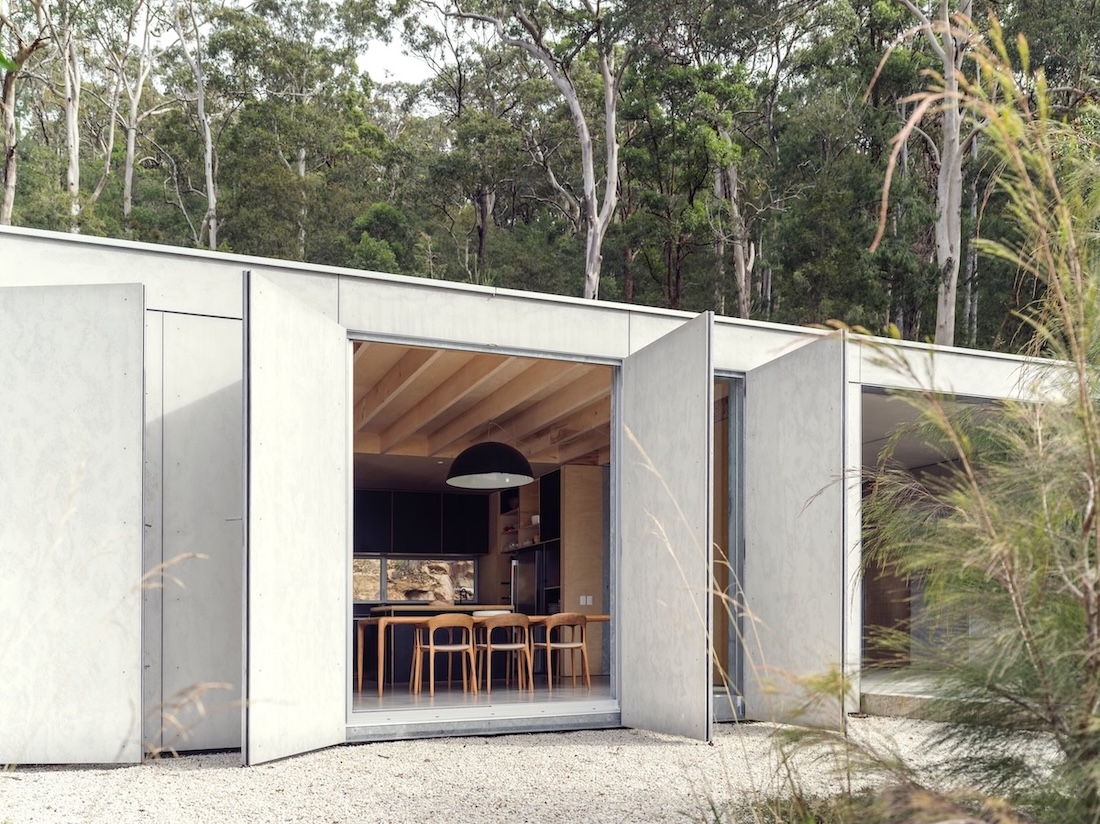
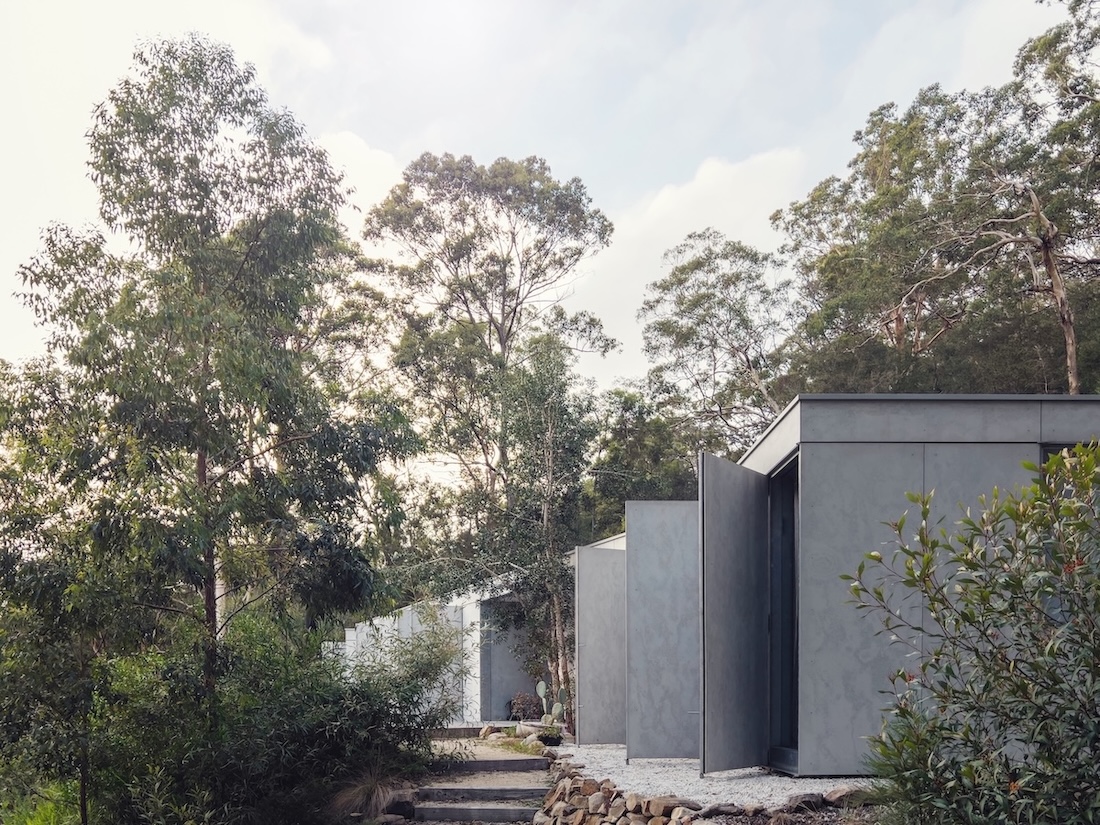
Set back from the road, and trading masonry for fibre-cement sheets and lawn for white pebbles, Amongst the Eucalypts proves that not all houses in bushfire zones have to look the same. Architect Jason Gibney first met the owners of this house around 10 years ago when it was no more than a vacant lot in dense eucalypt and casuarina bushland. Unhappy with their existing Development Approval, the owners asked Jason what he would do with the same site. Both families ended up travelling together to the site, which is at Seal Rocks about three hours north of Sydney.
Driving unsealed roads from Smiths Lake, they reached the site, then hiked up the hill until they found the view. It was here, sharing the view with the eagles, that they realised this was where the house should be built. “We bush bashed with [the clients] and their young kids, and ours, and as you got higher up the hill, you looked back and now you’re at a point where you still have trees above you, but now there’s trees below you too,” explains Jason. “And the entire place changed … you lost a sense of the unsealed road, the other residents disappeared … you lost a sense of the other properties as well.”
Obviously, designing a house in dense bushland is a fire risk and this site is in a Bushfire Attack Level–flame zone, the highest level. But Jason was not keen to follow the usual advice of brick construction and razing of trees to create lawns (or “green deserts” as he calls them) in “a box-ticking exercise” with no thought behind it.
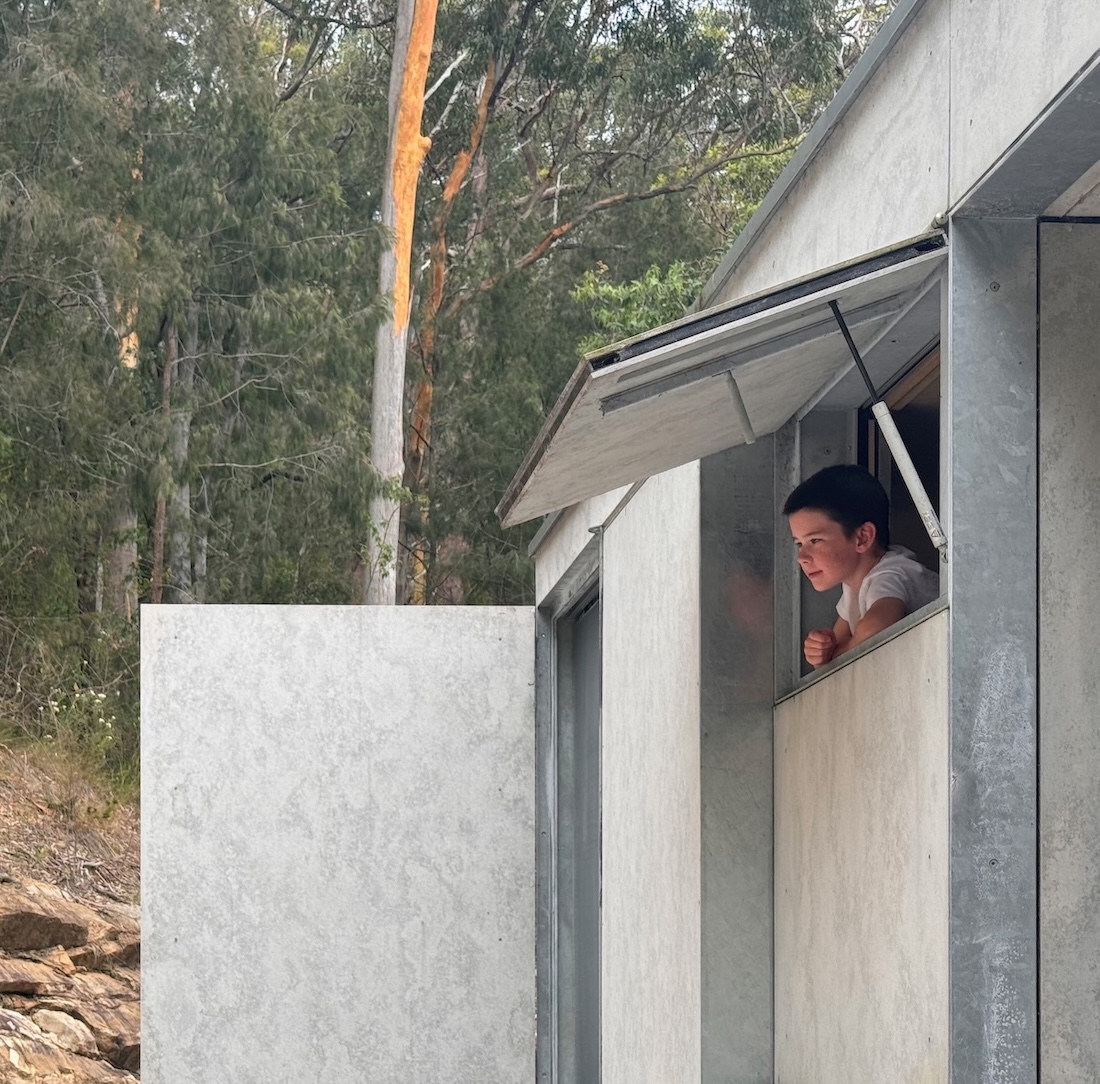
Instead, he worked closely with a fire consultant and the Rural Fire Service, asking question after question to drill down and see if the same solution could be reached in another way. “We want to understand all the whys,” says Jason. “And once we got to the root objectives, we worked back from that. What if we satisfy that in a different way?” Instead of ticking those boxes, the house was designed using a totally new, bespoke façade system with metal mesh shutters and screens for all the doors and windows so that the house can be completely folded up in a protective shell. The fibre-cement finishes on the outside of the house may be damaged but the fire-proof envelope is impermeable. Trees were thinned but not completely removed, and white pebbles were used outside instead of lawn, not only creating a fire break but also managing water runoff and preventing erosion.
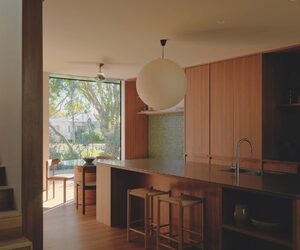
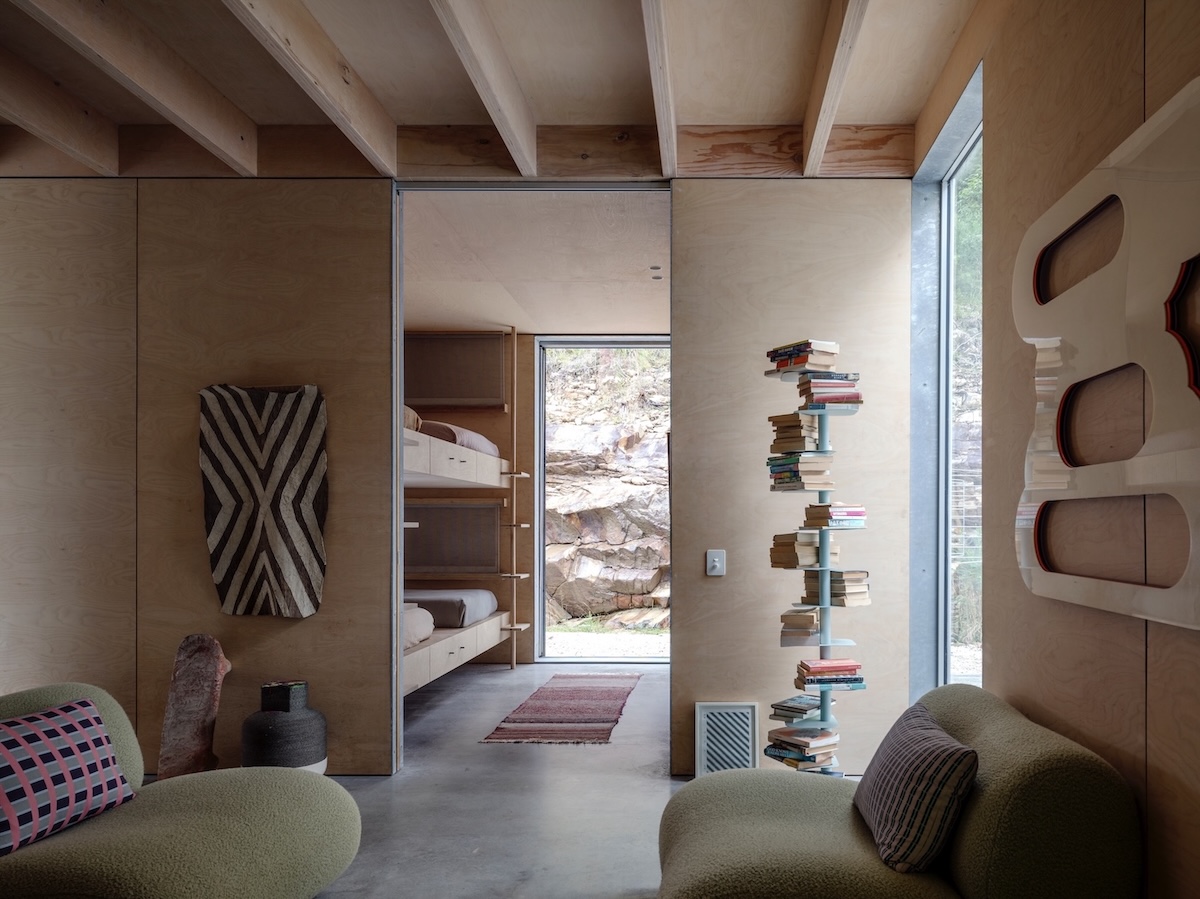
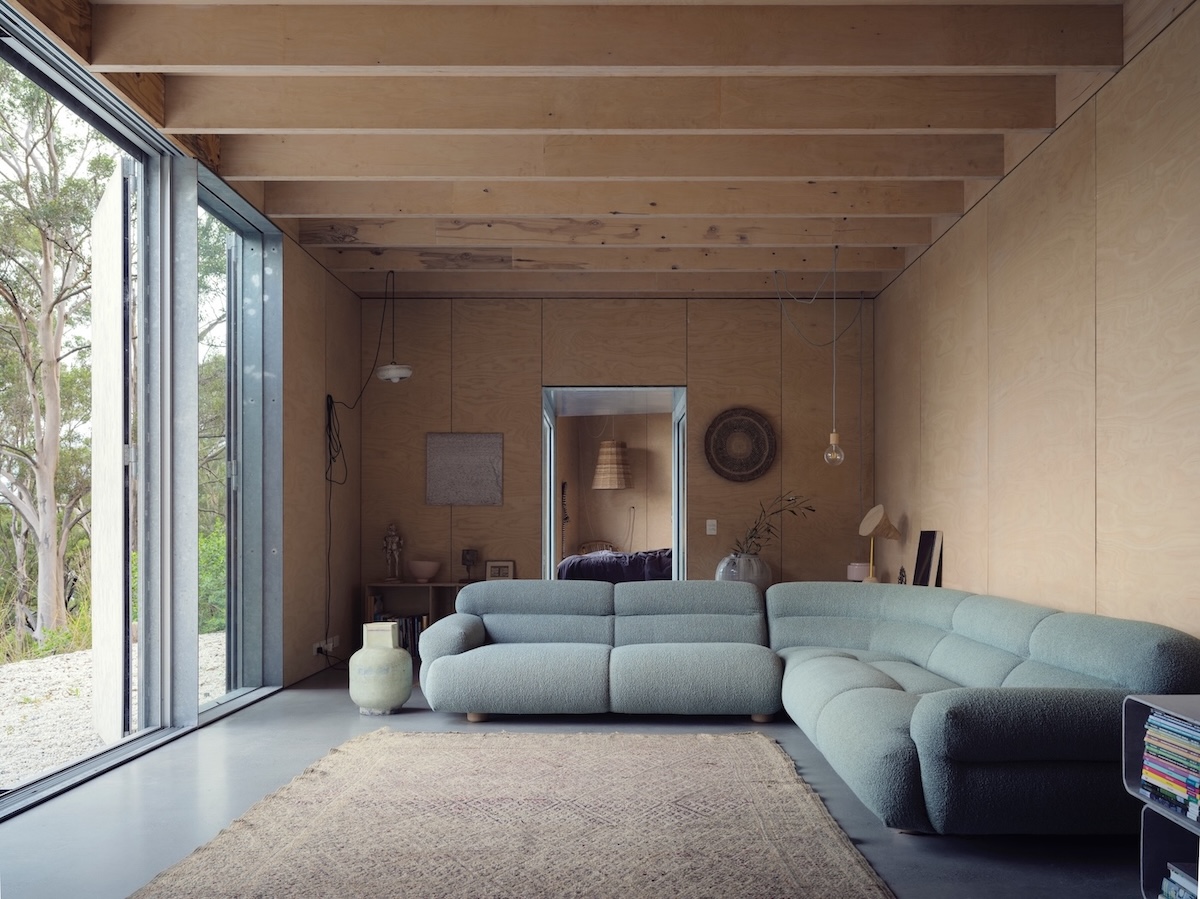
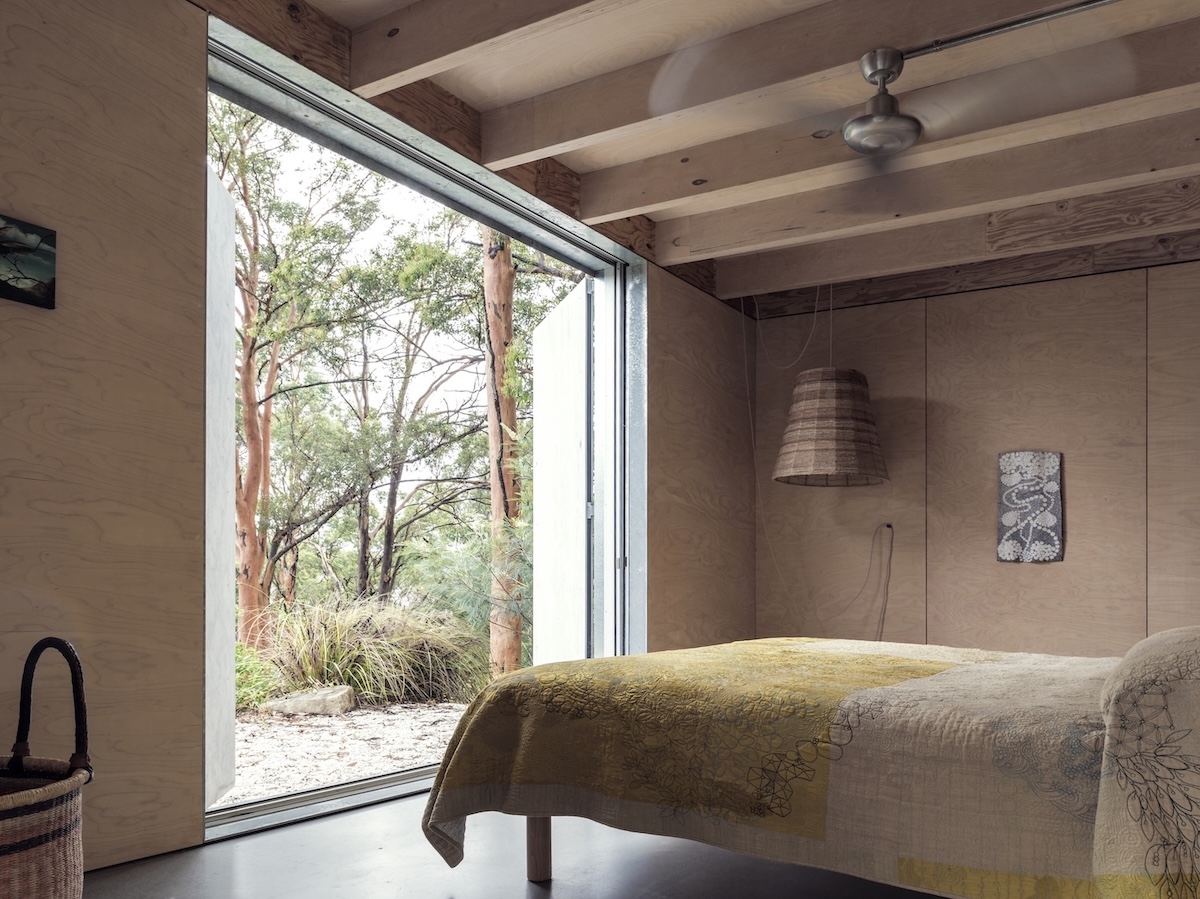
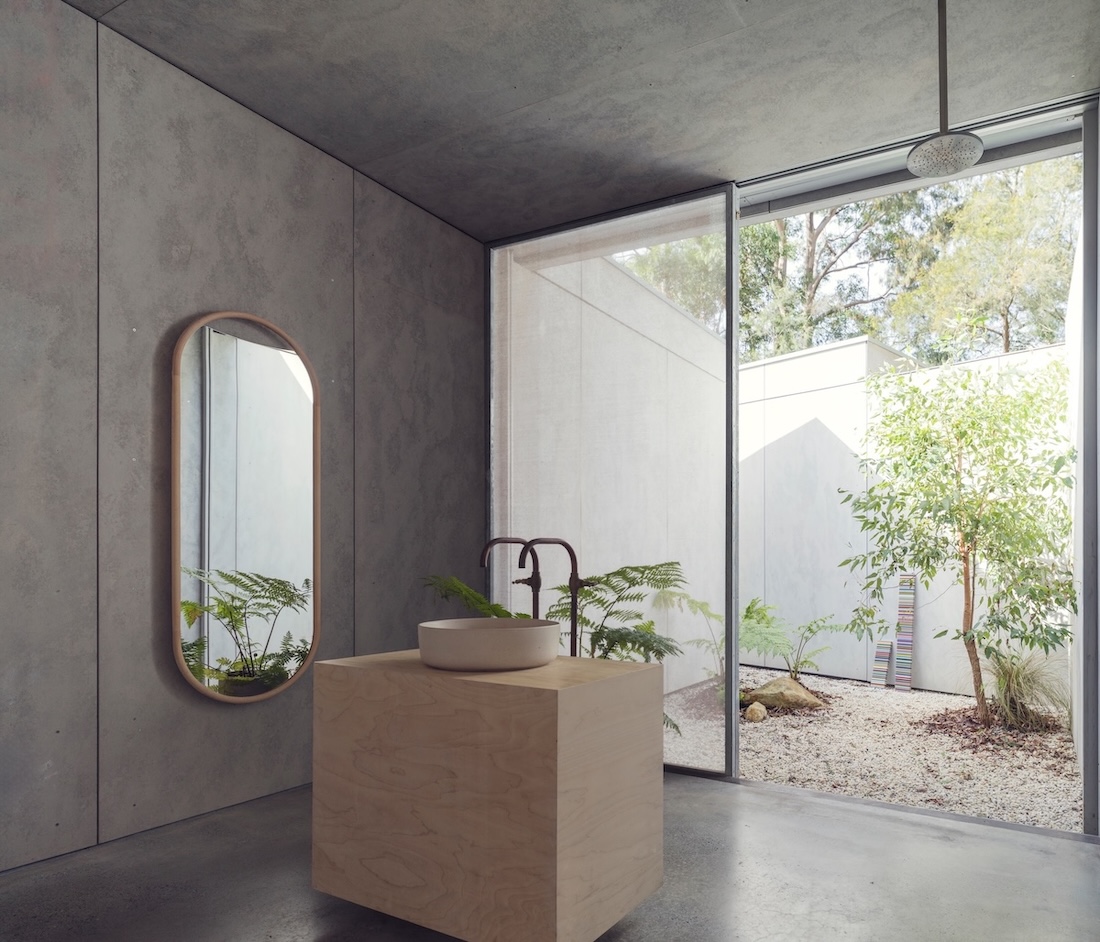
The house also had to be designed around the 20-degree slope of the hill. Rather than choosing to either excavate into the hillside or to build on stilts (which is problematic because leaf litter can be a fire risk), the house does a little of both, hugging the slope and using excavated rock to prop up the front of the home. The house is also split into pavilions, connected by breezeways and outdoor courtyards. This means that, wherever you are in the home, you are connected to the exteriors. The interiors are minimal with pine a uniting material and much of the furniture inbuilt. The whole effect, in muted tones of grey, white and pale timber, is more reminiscent of Japanese or Scandinavian design than an Australian vernacular. “A lot of our architecture is built on this premise that we try to simplify our palette of materials and allow the form and the detail and the spaces to express themselves. And we find that with a simple palette, it feels natural, more organic.”
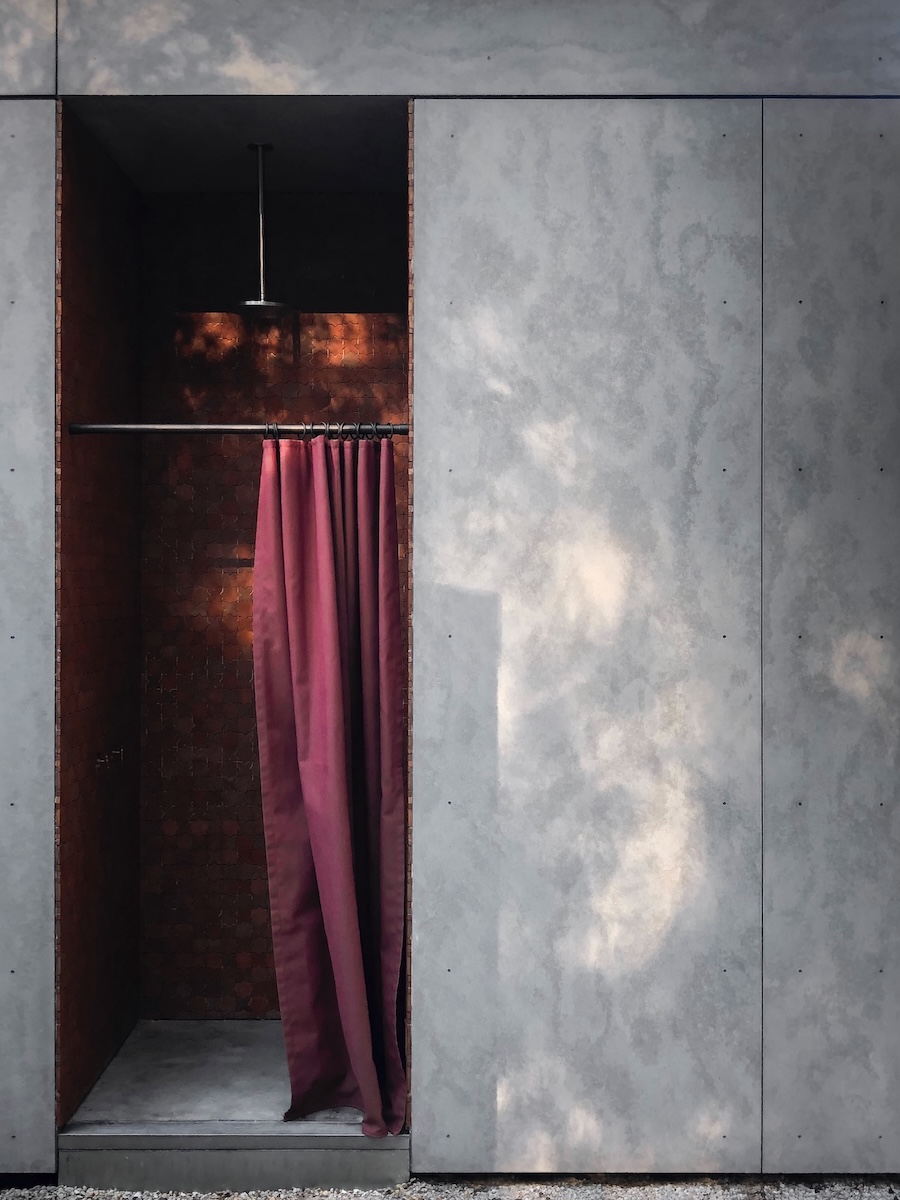
Another effect of the pavilion-like structure of the home is that bathing is experienced in concert with nature and greenery. Jason believes that bathing is more than just practical — it is a ritual that evokes many of the same sensations as being in nature. After having spent time in outdoor onsens in Japan, Jason wanted to bring the experience to this home. There is the option to bathe indoors and there is an outdoor shower with white pebbles underfoot, but there is also a third option. A doorway from the outside features a shower whose interior is clad in rich terracotta tiles with a burgundy shower curtain. The curtain doesn’t go to the ceiling, creating a gap above that allows you to see the sky and the landscape as you shower while protecting your modesty. “As a practice, a lot of our principles are driven around how we see bathing as a ritual, as a renewal exercise,” says Jason. “You know when you’re in water and you’re immersed in it that it’s so much more than just the function of getting clean. And there’s something about bathing that brings us back to our origins and nature.”
Bathing rituals aside, this home proves that you don’t need to build in the same position as your neighbours, nor with the same materials nor have the same lawn. Originality rules.
“Trees were thinned but not completely removed, and white pebbles were used outside instead of lawn.”
Specs
ARCHITECT
Jason Gibney Design Workshop (JGDW)
LOCATION
Worimi Country / Seal Rocks / NSW
PASSIVE ENERGY DESIGN
The house is deliberately compact in scale and carefully oriented. Passive solar design principles have guided its orientation, maximising light and warmth while shielding against prevailing southerly winds. A permeable system of pebbles and swales manage hillside runoff, preventing erosion and channelling water into gentle cascades that flow around the building. Durable, pre-finished materials minimise maintenance, while rainwater harvesting underpins a self-sufficient water supply.
MATERIALS
The home is a timber frame structured on a hydronic heated concrete floor slab, that is wrapped externally with a multi-layer system of fire-resistant fabric and waterproofing with an outer cladding of resilient compressed cement sheets reflective of the tones and textures of the surrounding bushland. In consultation with bushfire experts and using local trades and readily available materials, JGDW developed a bespoke system of operable façade panels that pivot open. Floor-to-ceiling metal mesh shutters and screens retract easily into wall pockets, allowing unimpeded breezes to flow and 360-degree views into the living spaces while providing protection from insects, reptiles, and airborne embers.
CONNECTION TO NATURE
The home is lightly anchored to the hillside and, though fully grounded, conveys a sense of suspension among the treetops, with filtered light and carefully framed sightlines revealing glimpses of the wider landscape and lake below and beyond. The plan breaks and twists along nature’s contours, creating courtyards, and outdoor pockets offering moments of solitude – to bathe in the forest or pause in shifting shade. Its modest scale evokes a sense not of inside/outside rooms but of being elevated and belonging to a larger landscape.
GLAZING
Alspec aluminium framed glazing that pockets into cavities in walls. Nilfire fire resistant glazing was also used for three windows that were intended to be without bushfire shutters.
HEATING AND COOLING
The house has floor-to-ceiling metal mesh shutters and screens that allow for unimpeded breezes to flow, protection from insects, reptiles, and airborne embers, and sufficient shading. Ceiling fans in bedrooms, and a concrete floor that remains cool in summer contribute to a passively cooled house. In winter the same concrete slab absorbs the sun’s rays and employs the properties of thermal mass to give back the absorbed warmth later in the evening. This is then supplemented further by a hydronic heating system within the concrete slab itself.
HOT WATER SYSTEM
Solar panels sited remotely on the property harvest energy to heat and provide electricity to power the house.
WATER TANKS
Water is stored in a below-ground tank which occupies the breezeway space between the two pavilions.
LIGHTING
The home is lit primarily by lamps which are operated with wall switches. Overhead downlights have been provided above benchtops and bathrooms. All the lights and lamps have dimmable control, creating a calm and quiet lighting environment for the evening time, where light comes from a low source within the space, evoking feelings of being lit by a campfire.